

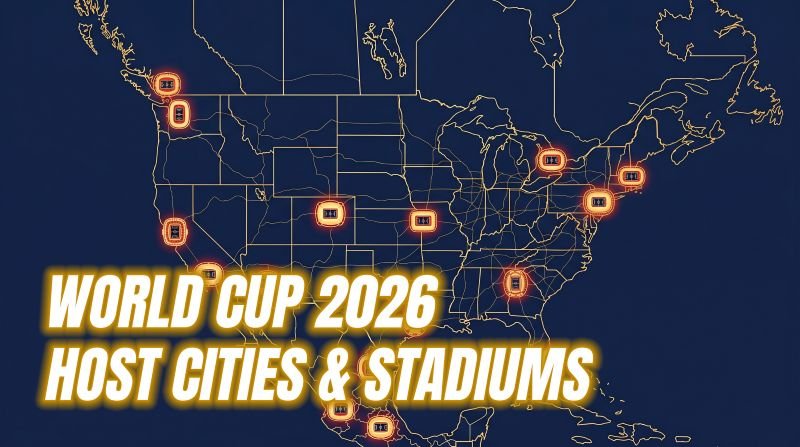
The World Cup 2026 will be hosted across three nations for the very first time in the tournament’s history. The United States, Canada, and Mexico will jointly stage the biggest football event on earth — featuring 48 teams, 104 matches, and 16 host stadiums spanning thousands of miles across North America.
So, let’s have a look at all 16 host cities and the World Cup 2026 stadiums one by one.
All 16 World Cup 2026 Stadiums at a Glance
| # | Stadium | City | Country | Capacity | Notable Matches |
|---|---|---|---|---|---|
| 1 | MetLife Stadium | New York/New Jersey | 🇺🇸 USA | 82,500 | 🏆 FINAL |
| 2 | Estadio Azteca | Mexico City | 🇲🇽 Mexico | 87,523 | Group Stage, R32 |
| 3 | AT&T Stadium | Dallas | 🇺🇸 USA | 80,000 | Semi-Final |
| 4 | Arrowhead Stadium | Kansas City | 🇺🇸 USA | 76,416 | Group Stage, KO |
| 5 | NRG Stadium | Houston | 🇺🇸 USA | 72,220 | Group Stage, KO |
| 6 | Mercedes-Benz Stadium | Atlanta | 🇺🇸 USA | 71,000 | Group Stage, KO |
| 7 | SoFi Stadium | Los Angeles | 🇺🇸 USA | 70,240 | Group Stage, KO |
| 8 | Lincoln Financial Field | Philadelphia | 🇺🇸 USA | 69,796 | Group Stage, KO |
| 9 | Lumen Field | Seattle | 🇺🇸 USA | 69,000 | Group Stage, KO |
| 10 | Levi’s Stadium | San Francisco Bay Area | 🇺🇸 USA | 68,500 | Group Stage, KO |
| 11 | Hard Rock Stadium | Miami | 🇺🇸 USA | 65,326 | Group Stage, KO |
| 12 | Gillette Stadium | Boston | 🇺🇸 USA | 65,878 | Group Stage, KO |
| 13 | Estadio BBVA | Monterrey | 🇲🇽 Mexico | 53,500 | Group Stage, R32 |
| 14 | BC Place | Vancouver | 🇨🇦 Canada | 54,500 | Group Stage, R32 |
| 15 | Estadio Akron | Guadalajara | 🇲🇽 Mexico | 49,850 | Group Stage, R32 |
| 16 | BMO Field | Toronto | 🇨🇦 Canada | 45,736 | Group Stage, R32 |
MetLife Stadium, New York / New Jersey
MetLife Stadium is the crown jewel of the 2026 World Cup — it will host the World Cup Final on July 19, 2026, as well as semi-final and other knockout stage matches. With a capacity of 82,500 seats, it is one of the largest stadiums in North America.
Located in East Rutherford, New Jersey, MetLife Stadium sits just 10 miles from Midtown Manhattan, making the New York/New Jersey metro area one of the most iconic settings in World Cup history. The stadium is home to both the NFL’s New York Giants and New York Jets and was one of the most high-profile venues selected for this tournament.
AT&T Stadium, Dallas
AT&T Stadium in Arlington, Texas, has a capacity of 80,000 seats (expandable to over 100,000), making it one of the largest venues in the tournament. The stadium will host matches through the knockout stages, including a semi-final.
Dallas is a major football hub in the southern United States. AT&T Stadium, home of the NFL’s Dallas Cowboys, is renowned for its retractable roof and the world’s largest column-free interior — a jaw-dropping setting for the World Cup’s biggest matches.
Arrowhead Stadium, Kansas City
Arrowhead Stadium is one of the loudest stadiums in the world, with a capacity of 76,416 seats. Kansas City is a passionate sports city, home to the NFL’s Kansas City Chiefs — two-time recent Super Bowl champions — and MLS’s Sporting KC.
The stadium will host group stage and knockout matches, and its legendary atmosphere is expected to provide some of the tournament’s most electric moments.
NRG Stadium, Houston
NRG Stadium in Houston, Texas, holds approximately 72,220 seats and features a retractable roof — essential for Houston’s hot and humid summer climate. Houston is the most diverse city in the United States and one of the largest football communities in North America.
Home to the NFL’s Houston Texans, NRG Stadium will host group stage and early knockout matches, with Houston’s vast Latin American fanbase expected to generate an incredible atmosphere.
Mercedes-Benz Stadium, Atlanta
Mercedes-Benz Stadium in Atlanta, Georgia, holds 71,000 seats and features a unique retractable roof with a distinctive eight-panel oculus design — one of the most architecturally striking arenas in the world. Atlanta is one of the fastest-growing cities in the United States and a major cultural hub.
Home to MLS’s Atlanta United FC (one of the best-supported clubs in American football history) and the NFL’s Atlanta Falcons, the stadium brings proven experience hosting top-level sporting events.
SoFi Stadium, Los Angeles
SoFi Stadium in Inglewood, California, holds 70,240 seats and is one of the most modern stadiums in the world, having opened in 2020. Los Angeles hosted the World Cup in 1994 and will bring one of the world’s most famous football cities back to the global stage.
The stadium hosted Super Bowl LVI in February 2022 and sits at the heart of the LA entertainment district. With one of the largest Hispanic populations of any US city, Los Angeles promises unforgettable atmosphere.
Lincoln Financial Field, Philadelphia
Lincoln Financial Field in Philadelphia, Pennsylvania, holds approximately 69,796 seats. Philadelphia is one of the oldest and most historically significant cities in North America, and its football fans are among the most passionate in the country.
Home to the NFL’s Philadelphia Eagles (Super Bowl LII champions), the stadium will host group stage and early knockout matches during the 2026 tournament.
Lumen Field, Seattle
Lumen Field in Seattle, Washington, has a capacity of approximately 69,000 seats. Seattle is home to one of the most loyal football supporter cultures in the United States, built by the MLS’s Seattle Sounders FC — consistently the best-attended club in American football.
The stadium is also known for generating extraordinary crowd noise, creating an intimidating atmosphere for visiting teams.
Levi’s Stadium, San Francisco Bay Area
Levi’s Stadium in Santa Clara, California, has a capacity of 68,500 seats. The San Francisco Bay Area is one of the world’s great cosmopolitan regions, with a deeply international and tech-forward fan base drawn from across the globe.
Home to the NFL’s San Francisco 49ers, Levi’s Stadium hosted Super Bowl 50 in 2016 and is well-equipped for major international events of this scale.
Hard Rock Stadium, Miami
Hard Rock Stadium in Miami Gardens, Florida, holds approximately 65,326 seats. Miami’s vast Latin American population makes it one of the most anticipated host cities of the entire tournament — fans from across South America and the Caribbean are expected in enormous numbers.
Home to the NFL’s Miami Dolphins, the stadium hosted Copa América 2024 matches and is no stranger to major football events.
Gillette Stadium, Boston
Gillette Stadium in Foxborough, Massachusetts, has a capacity of approximately 65,878 seats. Boston is one of the most historically significant cities in North America, with a rapidly growing football fanbase driven by the MLS’s New England Revolution.
Home to the NFL’s New England Patriots — one of the most successful franchises in American sports history — Gillette Stadium will host group stage matches during the 2026 tournament.
Estadio Azteca, Mexico City
Estadio Azteca is one of the most legendary football stadiums in the world and the largest venue in the 2026 World Cup with a capacity of approximately 87,523 seats. Located in the south of Mexico City, the Azteca is the home of the Mexican national team and Club América.
The stadium is where Diego Maradona scored both the infamous “Hand of God” goal and the “Goal of the Century” against England in 1986. It also hosted the 1970 World Cup Final between Brazil and Italy. In 2026, it will write a new chapter in its extraordinary history.
Estadio BBVA, Monterrey
Estadio BBVA in Guadalupe, Monterrey, holds approximately 53,500 seats and is widely considered one of the most beautiful stadiums in Latin America, set dramatically against the backdrop of the Sierra Madre mountains.
Monterrey is Mexico’s industrial capital and one of the country’s most passionate football cities, home to both Club Rayados and Club Tigres — fierce local rivals. The stadium opened in 2015 and is one of the most modern venues in the entire tournament.
Estadio Akron, Guadalajara
Estadio Akron in Zapopan, Guadalajara, has a capacity of approximately 49,850 seats. Guadalajara is Mexico’s second-largest city and one of its great footballing heartlands — home to Club Chivas de Guadalajara, arguably the most beloved club in Mexican football.
The stadium opened in 2010 and is the home of Chivas. Guadalajara’s passionate football culture will make it one of the most atmospheric host cities of the tournament.
BC Place, Vancouver
BC Place in Vancouver, British Columbia, holds approximately 54,500 seats and features a distinctive retractable roof that makes it a fully all-weather venue — important for Vancouver’s famously unpredictable climate. Vancouver is one of North America’s most beautiful cities, set between the Pacific Ocean and the Coast Mountains.
Home to MLS’s Vancouver Whitecaps, BC Place will host group stage and Round of 32 matches. Vancouver’s large Asian, South American, and European diaspora communities will bring exceptional colour and atmosphere to the tournament — making it one of the most internationally diverse host cities in 2026.
BMO Field, Toronto
BMO Field in Toronto, Ontario, has a capacity of approximately 45,736 seats, with expansion works carried out ahead of the 2026 tournament. Toronto is Canada’s largest city and one of the most multicultural cities in the world — a perfect reflection of the truly global nature of football.
Home to MLS’s Toronto FC, BMO Field will host group stage and Round of 32 matches, bringing the World Cup to Canada for the first time since 1986 when Mexico also hosted. Toronto’s enormous immigrant communities — including large South Asian, Caribbean, and South American populations — will make it an incredibly vibrant host city.
World Cup 2026: Match Allocation by Country
| Country | Cities | Matches | Stages |
|---|---|---|---|
| 🇺🇸 United States | 11 | 60 | Group Stage, R32, R16, QF, SF, Final |
| 🇲🇽 Mexico | 3 | 10 | Group Stage, Round of 32 |
| 🇨🇦 Canada | 2 | 10 | Group Stage, Round of 32 |
| Total | 16 | 104 | All stages |
Key Tournament Dates:
- Opening Match: June 11, 2026
- Group Stage: June 11–27, 2026
- Round of 32: June 28–30, 2026
- Round of 16: July 1–3, 2026
- Quarter-Finals: July 5–6, 2026
- Semi-Finals: July 8–9, 2026
- Third Place Match: July 12, 2026
- 🏆 Final: July 19, 2026 — MetLife Stadium, New Jersey
Frequently Asked Questions
Which stadium will host the 2026 World Cup Final?
How many stadiums will host the 2026 World Cup?
Which is the biggest stadium at the 2026 World Cup?
Which cities in the USA will host World Cup 2026 matches?
Which cities in Mexico will host World Cup 2026 matches?
Which cities in Canada will host World Cup 2026 matches?
Is Estadio Azteca hosting the 2026 World Cup Final?
Where will the 2026 World Cup semi-finals be played?
What is the most historic stadium at the 2026 World Cup?
When does the 2026 World Cup start and end?
Which World Cup 2026 stadium has the most atmosphere?
📚 Sources & References
This article is based on official data from:
- 🔗 FIFA Official Website — World Cup 2026
- 🔗 2026 FIFA World Cup — Wikipedia
- 🔗 2026 FIFA World Cup Venues — Wikipedia
All data is accurate as of April 2026.
Check out also: