

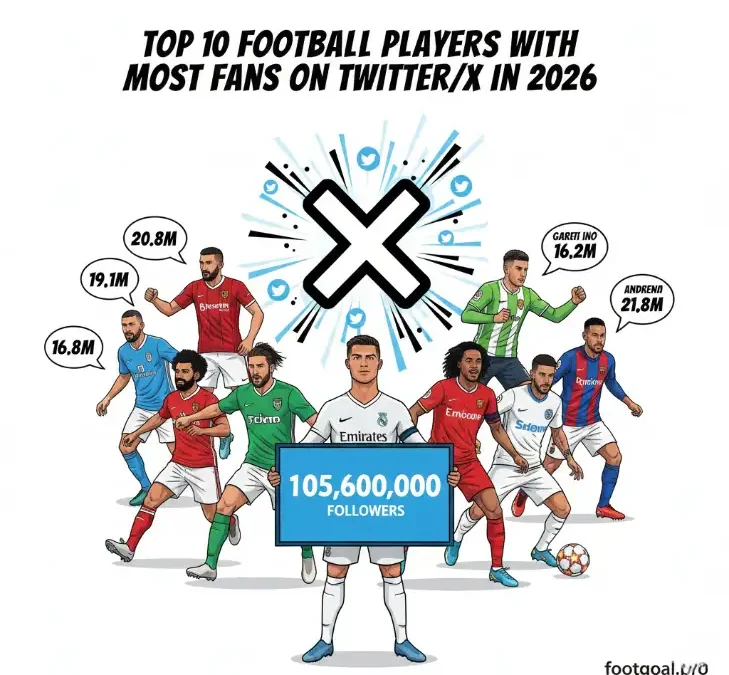
Twitter—or X as Elon Musk insists we call it now—represents football’s original social media battleground. Long before TikTok dances and Instagram Stories, this was where players built their digital empires, 280 characters at a time.
As of February 2026, the Twitter landscape looks fascinatingly different from newer platforms. This is where legacy meets longevity, where players who joined a decade ago still dominate, and where one man sits so far ahead of everyone else that second place might as well be last.
Check out also: Top 10 Most Followed Football Players in the World in 2026!
The Complete Twitter/X Rankings (February 2026)
| Rank | Player | Twitter/X Followers | Club/Status |
|---|---|---|---|
| 1 | Cristiano Ronaldo | 105,600,000 | Al-Nassr |
| 2 | Neymar | 58,300,000 | Al-Hilal |
| 3 | Kaka | 22,800,000 | Retired |
| 4 | Andres Iniesta | 21,800,000 | Emirates Club |
| 5 | Karim Benzema | 20,800,000 | Al-Ittihad |
| 6 | Mohamed Salah | 19,100,000 | Liverpool FC |
| 7 | Sergio Ramos | 18,800,000 | Retired |
| 8 | Ronaldinho | 18,200,000 | Retired |
| 9 | Gareth Bale | 16,800,000 | Retired |
| 10 | James Rodriguez | 16,400,000 | Rayo Vallecano |
1. Cristiano Ronaldo – 105.6 Million Followers
Club: Al-Nassr
Twitter/X Followers: 105,600,000
Age: 41 years old
Cristiano Ronaldo having 105.6 million Twitter followers is less a statistic and more a statement of total platform dominance. He’s got nearly double Neymar’s count in second place. That’s not just winning—that’s lapping the field.
Ronaldo joined Twitter in 2010, back when the platform was still figuring out what it wanted to be. He understood immediately that this was a direct line to hundreds of millions of fans without media filters, PR agencies, or anyone else controlling the narrative.
The Twitter Strategy
Ronaldo’s Twitter game is calculated but effective. He tweets 2-4 times per week, usually a mix of match updates, sponsor content, motivational messages, and occasional personal moments. Every tweet is professionally crafted, often in multiple languages to maximize global reach.
His engagement numbers are absurd. A simple “Vamos!” after a match gets 200K-500K likes. Sponsor tweets hit 100K-300K. Major announcements or personal milestones can crack 1-2 million likes. That’s Super Bowl commercial reach for free.
The Historical Advantage
Being an early adopter matters enormously on Twitter. Ronaldo built his following during Twitter’s explosive growth phase (2010-2015) when he was in his prime at Real Madrid. New followers accumulated like compound interest—millions per year when the platform was hot.
Younger players joining Twitter in 2020 or later face a much harder climb. The platform’s growth has plateaued, users have moved to visual platforms, and attention is fragmented. Ronaldo’s 105M represents 15+ years of accumulated followers that nobody starting today could replicate.
The Engagement Reality
Here’s the truth: Ronaldo’s Twitter engagement rate is lower than his Instagram or YouTube. With 105M followers, he should theoretically get more than 500K likes per post. The discrepancy shows that many followers are inactive accounts, bots, or people who followed years ago and moved on.
But it doesn’t matter. The number itself is the flex. Having 105M Twitter followers signals global influence that transcends any single platform’s current relevance. It’s a legacy metric that nobody else in football can touch.
The Commercial Value
Brands pay $200,000-500,000 for a Ronaldo tweet, even though his engagement rate is lower than smaller accounts. Why? Because his follower count includes journalists, influencers, celebrities, and decision-makers who amplify his message far beyond the initial tweet.
One Ronaldo tweet about a product can generate thousands of articles, millions of secondary social shares, and global news coverage. That amplification effect is what brands are actually buying.
2. Neymar – 58.3 Million Followers
Club: Al-Hilal
Twitter/X Followers: 58,300,000
Age: 34 years old
Neymar’s 58.3 million Twitter followers make him a distant second to Ronaldo, but he’s still miles ahead of everyone else. The gap between second and third place (35.5 million) is larger than most footballers’ entire followings.
What separates Neymar from other players is that he actually uses Twitter like a normal person—well, a normal person with 58 million followers. He tweets reactions to matches, replies to fans, throws shade at critics, posts memes, and shows personality that feels authentic rather than managed.
The Engagement King
Neymar’s engagement rate destroys Ronaldo’s. His tweets regularly hit 100K-300K likes despite having half the followers. His reply game is strong—he’ll respond to random fans, retweet highlights, and engage in banter that keeps his audience invested.
This engagement matters more than raw follower count for algorithmic reach. Twitter promotes content that generates conversation, and Neymar’s personality-driven approach creates way more conversation than Ronaldo’s polished broadcasts.
The Controversy Magnet
Neymar’s Twitter has been the source of countless controversies—diving debates, transfer sagas, PSG drama, referee complaints. Every controversy generates millions of engagements from supporters and haters alike.
Smart brands avoid controversy. Smart personal brands leverage it. Neymar understands that being polarizing keeps you relevant. His critics engage with his content as much as his fans, and Twitter’s algorithm doesn’t distinguish between positive and negative engagement.
The Multi-Platform Balance
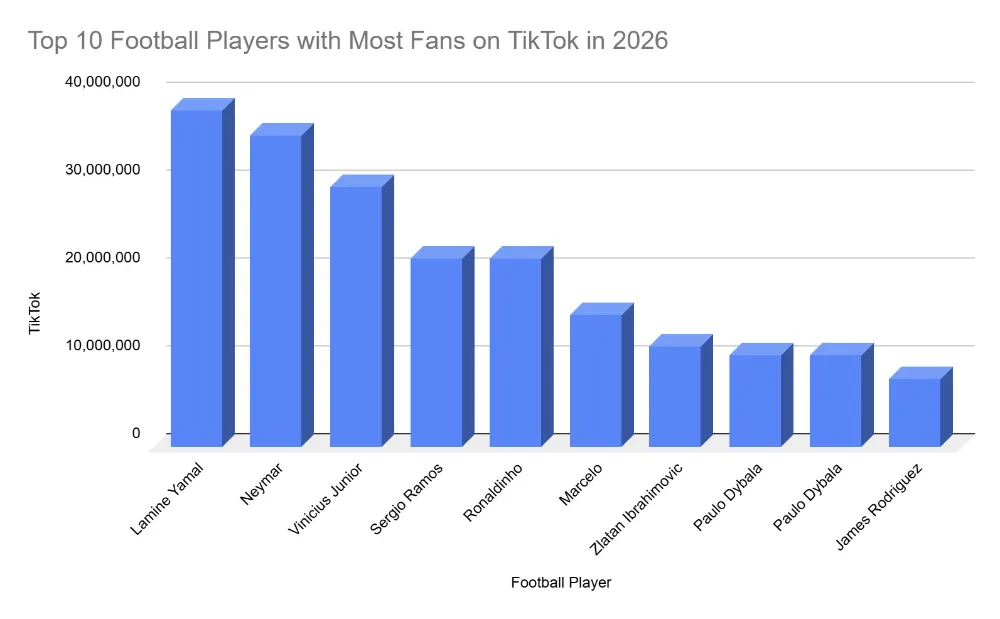
Unlike Ronaldo who prioritizes YouTube, or younger players who focus on TikTok, Neymar maintains strong presence across all platforms. His 58M Twitter followers complement his 224M Instagram, 35M TikTok, and 5.5M YouTube subscribers. That diversification protects against any single platform declining.
3. Kaka – 22.8 Million Followers
Status: Retired
Twitter/X Followers: 22,800,000
Age: 43 years old
Kaka being third with 22.8 million followers despite retiring in 2017 is one of Twitter’s most fascinating stories. This is what happens when you join early, build smartly, and maintain a positive public image that ages like fine wine.
Kaka joined Twitter in 2009—before Ronaldo, before most footballers even understood what social media was. He was tweeting when Twitter was still figuring out how to handle celebrity accounts. That early adopter advantage built a foundation that still pays dividends today.
The Wholesome Brand
Kaka’s entire Twitter presence is aggressively wholesome. Faith, family, charity work, motivational quotes, and occasional football commentary. Zero scandals, zero drama, zero controversy. In an era where every tweet can become a headline, Kaka’s feed is remarkably drama-free.
That wholesomeness has protected his follower count through retirement. People don’t unfollow Kaka because there’s no reason to. He’s not annoying, not controversial, not flooding timelines with sponsor posts. He’s just… there, being Kaka, and that’s enough.
The Real Madrid Effect
Kaka built most of his following during his Real Madrid years (2009-2013) when Twitter was exploding globally and Real Madrid was the most-followed club on the platform. The combination of elite club, global reach, and perfect timing created follower growth that players today can’t replicate.
The Inactive Advantage
Kaka tweets maybe 1-2 times per month now. His engagement per tweet is modest—20K-50K likes. But here’s the thing: Twitter followers don’t disappear when you go inactive. They just sit there, inflating your count, giving you credibility, and occasionally engaging when you do post.
Active players working their asses off on Twitter every day would kill for Kaka’s follower count. He built it over a decade ago and now coasts on that legacy while focusing on other ventures.
4. Andres Iniesta – 21.8 Million Followers
Club: Emirates Club
Twitter/X Followers: 21,800,000
Age: 41 years old
Iniesta’s 21.8 million followers represent the quiet accumulation of respect over 15+ years on the platform. No flash, no drama, no desperate grabs for attention—just one of football’s greatest midfielders sharing his journey.
Like Kaka, Iniesta benefited massively from the Barcelona golden era (2008-2018) when the club dominated football and Twitter was surging in popularity. Every Champions League triumph, every Clasico victory, every World Cup memory added millions of followers.
The Understated Approach
Iniesta tweets infrequently and without fanfare. Match updates from Emirates Club, throwback photos from Barcelona, family moments, wine business promotions (he owns a vineyard). Everything is understated, classy, and on-brand with his personality.
His engagement is solid—30K-80K likes per tweet—which is excellent given his posting frequency. His audience is genuinely interested in his life rather than mindlessly scrolling. Quality over quantity.
The Spain Connection
Iniesta’s 2010 World Cup-winning goal against Netherlands made him a Spanish national hero forever. That singular moment created millions of followers who’ll never unfollow. The goal is replayed endlessly, and every replay reminds people to follow his Twitter if they haven’t already.
The Longevity Play
Still playing professionally at 41 keeps Iniesta relevant in ways fully retired players aren’t. His tweets about current matches show he’s still in the game, still competing, still part of football’s active conversation rather than just its history.
5. Karim Benzema – 20.8 Million Followers
Club: Al-Ittihad
Twitter/X Followers: 20,800,000
Age: 38 years old
Benzema’s 20.8 million followers reflect a career arc that took him from underappreciated to Ballon d’Or winner. His Twitter following grew slowly during his years in Ronaldo’s shadow at Real Madrid, then exploded when he became the main man.
His move to Saudi Arabia in 2023 hasn’t hurt his Twitter presence. If anything, it’s given him new content angles—different league, different lifestyle, different chapter. His followers have stayed engaged through the transition.
The Late Bloomer
Benzema didn’t become a Twitter force until his late career renaissance. His follower growth in 2021-2023 (during his Ballon d’Or campaign and move to Saudi) exceeded his entire previous decade on the platform. Winning changes everything.
His tweets are minimal—mostly match content, sponsor posts, and occasional personal moments. He’s not trying to be Twitter’s most active player. He’s just maintaining presence while focusing on football and his various business ventures.
The French Connection
Benzema’s French fanbase is rabidly loyal despite his complicated relationship with the national team. His 2022 World Cup snub and subsequent move to Saudi Arabia created controversy that actually boosted his Twitter engagement. People defending him, people criticizing him—all generating engagement.
6. Mohamed Salah – 19.1 Million Followers
Club: Liverpool FC
Twitter/X Followers: 19,100,000
Age: 33 years old
Mo Salah having 19.1 million Twitter followers makes him the only active Premier League player in the top 10, which says something about Twitter’s geographic and demographic distribution. The platform is bigger in certain markets—Spanish-speaking countries, Brazil, Middle East—than others.
Salah’s Twitter presence is professionally managed but maintains authenticity. Match updates, sponsor content, social causes (particularly related to Egypt and the Middle East), and occasional personal glimpses. Everything is on-brand with his image as the humble superstar.
The Liverpool Explosion
Salah’s follower count exploded after joining Liverpool in 2017. His incredible first season (44 goals) coincided with Twitter still being culturally relevant, and his underdog story (rejected by Chelsea, proved everyone wrong) created a compelling narrative that drove follows.
His engagement is strong—50K-150K likes per tweet—showing his audience is genuinely invested rather than just legacy followers. Liverpool’s global fanbase amplifies everything he posts.
The Social Conscience
Salah uses Twitter more purposefully than most players for social causes. Egyptian politics, Palestinian rights, charity work, Muslim representation in football—he’s willing to tweet about issues beyond football that many players avoid.
This authenticity matters. His followers aren’t just football fans—they’re people who respect him using his platform for more than self-promotion. That deeper connection drives better engagement and more loyal following.
The Arabic Market
Salah is the biggest football star in the Arab world, and Twitter is massive in Middle Eastern markets. His Arabic-language tweets get comparable engagement to his English ones, showing he’s genuinely reaching diverse global audiences rather than just English-speaking fans.
7. Sergio Ramos – 18.8 Million Followers
Status: Retired
Twitter/X Followers: 18,800,000
Age: 39 years old
Ramos’s 18.8 million Twitter followers were built during one of the most decorated careers in football history. Four Champions Leagues, World Cup, multiple Euros, countless clutch moments—every trophy added followers, every legendary performance brought new fans.
His Twitter personality matches his on-field persona: confident, occasionally confrontational, never backing down. He’ll argue with critics, defend teammates, and throw subtle shade at former rivals. It makes for entertaining content even in retirement.
The Madrid Legacy
Most of Ramos’s followers came during his Real Madrid years (2005-2021) when he was simultaneously one of the best defenders in the world and one of the most controversial. The combination of elite performance and endless drama created perfect Twitter content.
Every red card, every last-minute goal, every Clasico confrontation became Twitter moments that drove follows. Love him or hate him, you followed Ramos’s Twitter to see what he’d say next.
The Retirement Transition
Since retiring, Ramos has maintained presence through fitness content, family posts, and occasional football commentary. His engagement has dropped (20K-60K likes per tweet) but remains solid for a retired player not creating daily content.
8. Ronaldinho – 18.2 Million Followers
Status: Retired
Twitter/X Followers: 18,200,000
Age: 45 years old
Ronaldinho’s 18.2 million Twitter followers is remarkable considering he’s been retired since 2015. This is pure nostalgia and personality carrying a Twitter account for over a decade after the football ended.
His Twitter content is wonderfully random—skills videos from beach football, throwback photos from Barcelona, birthday wishes to other players, random musings. There’s no strategy, no content calendar, just Ronaldinho being Ronaldinho whenever he feels like tweeting.
The Timeless Appeal
Ronaldinho represents a specific era of football that millions of fans consider the golden age. His Twitter followers aren’t just following a retired player—they’re maintaining connection to the memories he represents. Every tweet is a reminder of magic that doesn’t exist in modern football.
The Engagement Paradox
Ronaldinho’s engagement is surprisingly strong given his sporadic posting. When he does tweet, he gets 40K-100K likes, sometimes more if it’s a throwback video or special message. His audience might not be growing, but they’re still there, still engaged, still caring about what he has to say.
The Brand Endurance
Ronaldinho’s smile is one of football’s most iconic images, and that translates to social media staying power. He could not tweet for six months, come back with a random post, and still get massive engagement. The brand is that strong.
9. Gareth Bale – 16.8 Million Followers
Status: Retired
Twitter/X Followers: 16,800,000
Age: 36 years old
Bale’s 16.8 million followers were accumulated during his years as one of the world’s most expensive and marketable players. His 2013 transfer to Real Madrid for a then-world-record fee created massive global attention that translated directly to Twitter follows.
Post-retirement, Bale’s Twitter has become refreshingly honest. Golf content, Wales football support, occasional football commentary, and zero pretense about staying in the sport. He’s living his best life and tweeting about it without caring what football purists think.
The Real Madrid Boost
Bale’s follower count exploded during his first two seasons at Madrid (2013-2015) when he was scoring Champions League final goals and looking like the next global superstar. Those years built a foundation that retirement hasn’t eroded.
The Wales Factor
Bale is Welsh football royalty, and his entire nation follows his Twitter. His tweets about Welsh football get outsized engagement relative to his typical posts. He’s not just a retired footballer—he’s a national icon, and that maintains relevance.
The Personality Win
Bale’s post-retirement Twitter presence is better than his playing-career Twitter because he’s finally being himself. The “Wales. Golf. Madrid. In that order” meme became reality, and fans appreciate the authenticity after years of corporate PR.
10. James Rodriguez – 16.4 Million Followers
Club: Rayo Vallecano
Twitter/X Followers: 16,400,000
Age: 34 years old
James Rodriguez closing out the top 10 with 16.4 million followers is testament to what one incredible World Cup can do for a career. His 2014 Golden Boot performance created global superstardom that his subsequent club career never quite lived up to—but the Twitter followers remained.
His Twitter presence is consistent if unspectacular. Match updates from Rayo Vallecano, sponsor content, Colombian national team support, and family moments. He’s not trying to break the internet—just maintaining connection with a fanbase that’s been loyal through career ups and downs.
The 2014 World Cup Legacy
James’s volley against Uruguay is one of the great World Cup goals, and it played on loop for months in 2014 when Twitter was still culturally dominant. That goal alone probably generated 5+ million followers. The Golden Boot converted those highlight viewers into permanent followers.
The Colombian Connection
Colombia’s population is 51 million, and James is their greatest footballer of the modern era. His Spanish-language tweets get massive engagement from Colombian fans who treat him like royalty regardless of which club he’s playing for.
The Career Renaissance
James’s move to Rayo Vallecano and return to decent form has revitalized his Twitter engagement. Fans who’d written him off are re-engaging, and his tweets about performing well are getting better numbers than they have in years. Comebacks are great content.
What This Ranking Actually Tells Us
The Twitter/X top 10 reveals a platform stuck between its glorious past and uncertain future.
Legacy Dominates
Six of the top 10 are retired or semi-retired. This isn’t because retired players are better at Twitter—it’s because Twitter’s peak relevance coincided with these players’ peak careers. They built massive followings when the platform mattered most, and those followers haven’t disappeared.
Early Adoption Wins
Every player in the top 10 joined Twitter before 2015. That’s not coincidence—it’s when the platform was growing explosively. Players joining after 2018 face a fundamentally different landscape where Twitter growth has stalled and user attention has fragmented.
Young Stars Are Absent
Haaland, Mbappe, Yamal, Bellingham—the new generation of superstars—are nowhere near this list. They’re crushing it on Instagram and TikTok but largely ignoring Twitter. This tells you everything about the platform’s demographic shift.
Geography Matters
The top 10 is heavy on Spanish-speaking players and completely absent of African players beyond Salah. Twitter’s strength in Latin America, Spain, and the Middle East creates follower distribution that doesn’t match football’s actual global footprint.
Engagement Doesn’t Match Followers
Many players in this top 10 have better engagement rates on Instagram or TikTok despite having fewer followers there. Twitter follower counts are increasingly legacy metrics rather than indicators of actual influence.
Platform Comparison: Twitter vs. Instagram vs. TikTok vs. YouTube
How do these same players perform across different platforms?
| Player | Twitter Followers | Instagram Followers | TikTok Followers | YouTube Subscribers |
|---|---|---|---|---|
| Ronaldo | 105,600,000 | 650,000,000 | 9,200,000 | 78,100,000 |
| Neymar | 58,300,000 | 224,000,000 | 35,400,000 | 5,480,000 |
| Salah | 19,100,000 | 65,000,000 | N/A | N/A |
| Benzema | 20,800,000 | 85,000,000 | N/A | N/A |
| Ramos | 18,800,000 | 60,000,000 | 21,400,000 | 610,000 |
The pattern is clear: Instagram dominates for every player except where YouTube has become a focus (Ronaldo). Twitter follower counts are respectable but don’t indicate primary platform focus for anyone.
Twitter’s Evolving Role in Football
The News Platform
Twitter’s remaining strength is breaking news. Transfer announcements, injury updates, match results—Twitter is still the fastest way for information to spread in football. Players maintain presence because that’s where journalists and news aggregators live.
The Debate Platform
Football Twitter thrives on argument. Every controversial moment generates hours of debate, thousands of tweets, and viral engagement. Players benefit from this even when they’re not actively participating—their names trend, their follower counts grow from the visibility.
The Decline in Youth Engagement
Anyone under 25 primarily uses Instagram, TikTok, and YouTube. They might have Twitter accounts, but they’re not actively engaging. This creates a long-term problem: as Twitter’s user base ages, footballer accounts that depend on young fans will see declining engagement even as follower counts remain stable.
The Blue Check Chaos
Musk’s changes to verification created chaos where anyone can buy a blue checkmark. This devalued the status symbol that verified accounts represented and made it harder to distinguish real player accounts from impersonators. Several players have mentioned receiving less engagement since the verification changes.
Content Strategies That Work on Twitter
Match Updates Win
Tweets posted within 30 minutes of a match finishing get 3-5x more engagement than off-day tweets. The Twitter audience wants real-time reactions, not curated content posted days later.
Controversy Drives Engagement
Neymar’s most-engaged tweets are usually controversial takes or responses to criticism. Twitter rewards hot takes and arguable positions more than bland positivity.
Short and Sweet
Twitter’s character limit isn’t a bug, it’s a feature. Tweets under 100 characters get better engagement than maximum-length essays. “Vamos!” outperforms three paragraphs of gratitude.
Visual Content Helps
Tweets with images or videos get 2-3x more engagement than text-only. Even a simple training photo makes a huge difference in visibility and engagement.
Timing Matters
Posting during peak hours (7-9 PM in major markets) significantly boosts immediate engagement, which signals to the algorithm to promote the tweet further. Dead-zone posting kills visibility.
The Messi Mystery
The elephant in the room: where’s Messi?
Messi has roughly 44 million Twitter followers—enough to make this top 10—but his complete lack of engagement keeps him off lists of influential football Twitter accounts. He tweets maybe once a month, usually sponsored content or official announcements. He doesn’t reply to fans, doesn’t engage with trends, doesn’t participate in Twitter culture.
His Instagram has 520 million followers with regular posts and solid engagement. His Twitter is essentially abandoned. It’s the clearest example of a superstar making a strategic platform choice and completely ignoring alternatives.
For Messi, Twitter’s text-based, debate-heavy culture doesn’t match his reserved personality. Instagram’s visual-first approach lets him share without saying much. That choice has cost him Twitter influence but hasn’t hurt his overall brand at all.
The Future of Football Twitter
Declining Youth Adoption
No young stars are building massive Twitter followings anymore. Haaland joined in 2018 and has 8M followers. Yamal has barely 2M. Compare that to their TikTok and Instagram numbers. Twitter is where millennial and Gen-X football fans live—not Gen-Z.
The Transfer News Stronghold
As long as Fabrizio Romano and other transfer journalists use Twitter as their primary platform, football Twitter will remain relevant for breaking news. But that’s a narrow use case compared to the platform’s former cultural dominance.
The Elon Factor
Musk’s ownership and rebranding to X has been chaotic. Algorithm changes, verification chaos, and erratic policy decisions have frustrated users and creators. If Twitter/X continues declining in cultural relevance, even legacy follower counts won’t matter much.
The Archive Value
Twitter accounts are becoming historical archives. Players might not tweet much, but their accounts document their careers in real-time tweets going back a decade+. That archive has value even if daily engagement drops.
FAQ: Everything You Want to Know
Who is the most followed football player on Twitter/X in 2026?
Why doesn’t Lionel Messi appear in the Twitter top 10?
How many Twitter followers does Neymar have?
Why do retired players dominate Twitter more than newer platforms?
How has the Twitter rebrand to X affected football players?
Why is Kaka still in the top 3 despite retiring in 2017?
Do Twitter followers translate to commercial value for players?
Why are young stars like Haaland and Mbappe not in the top 10?
How often do top football players actually tweet?
What type of content performs best on Twitter for footballers?
Is Twitter still relevant for footballers in 2026?
Why does Gareth Bale still have so many followers despite retiring?
Final Thoughts
The Twitter/X rankings of February 2026 tell the story of a platform past its prime, coasting on legacy while newer platforms capture football’s future.
Cristiano Ronaldo’s 105.6 million followers represent the high-water mark of what Twitter once was—the premier platform for athletes to build direct relationships with global fanbases. But look closer and you’ll see the cracks. His engagement rate is mediocre. Most of his followers are inactive or legacy accounts. The cultural momentum has shifted elsewhere.
The dominance of retired players—Kaka, Ronaldinho, Bale—isn’t a testament to their enduring appeal. It’s evidence that Twitter’s growth era is over. These players built massive followings when the platform mattered most (2009-2015), and those followers haven’t left even though the players and the platform’s relevance both have.
The absence of young stars is the clearest signal. Where’s Haaland? Where’s Mbappe? Where’s Yamal? They’re crushing it on Instagram and TikTok while treating Twitter as an afterthought. They joined after the platform’s cultural peak and correctly identified that their generation isn’t there.
But here’s the thing: Twitter still matters for specific use cases. Breaking transfer news. Real-time match reactions. Controversial debates. Direct communication with journalists and media. It’s become a utility platform rather than a growth platform—necessary but not exciting.
For players in the top 10, their Twitter follower counts are badges of honor representing their stature during the platform’s golden era. For younger players trying to build brands today, Twitter is somewhere between an obligation and an irrelevance—something you maintain because it exists, not because it drives meaningful growth.
Looking ahead, Twitter follower counts will become increasingly disconnected from actual influence. A player with 20 million Twitter followers might have less real impact than one with 5 million TikTok followers and strong engagement. The metric will persist, but its meaning will fade.
The rankings will likely remain stable for years simply because growth has stalled for everyone. Ronaldo will keep his massive lead. Retired players will maintain their positions. Active players will see slow growth that never catches the veterans. It’s a frozen leaderboard from a platform that froze in time.
Twitter gave us a decade of direct athlete-to-fan connection that changed sports marketing forever. The top 10 represents the players who maximized that opportunity when it mattered most. But the future of football social media is being written on other platforms, in other formats, by other players who understand that 280 characters and algorithmic chaos can’t compete with TikTok videos and Instagram Stories.
The Twitter era isn’t over, but its glory days are. These rankings are monuments to what was, not indicators of what’s next.