
FootGoal Bernabéu Revenue Audit™: Key Takeaways
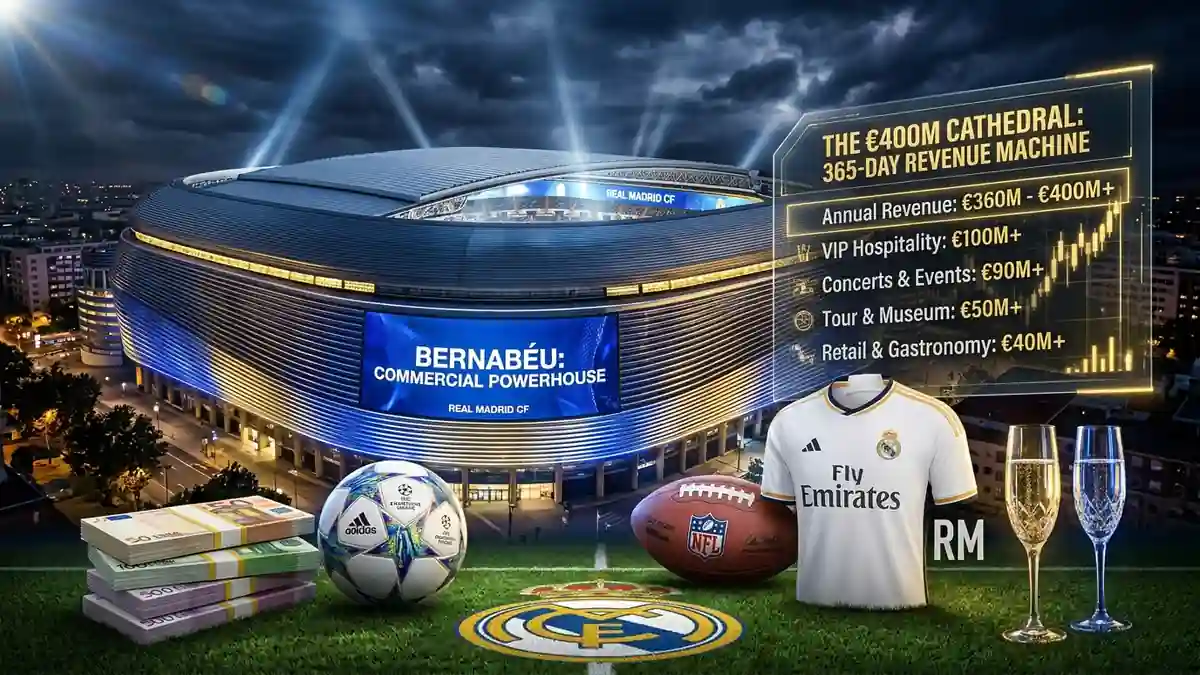
- The €400M Annual Target: The fully operational New Santiago Bernabéu generates between €360 million and €400 million per season in total stadium revenue, more than doubling the club’s pre-renovation baseline of €175 million.
- The Subterranean Hypogeum: Real Madrid invested €225 million into an underground 30-metre greenhouse system that stores the playing pitch in six mechanized trays, freeing the arena to host 300+ non-football events a year without damaging the turf.
- VIP Hospitality Goldmine: Premium seating, executive boxes, and the breathtaking 360-degree ‘SkyBar’ generate over €105 million annually, transforming matchdays into high-margin luxury corporate experiences.
- The Sixth Street & Legends Deal: Real Madrid secured an upfront cash injection of €360 million from US investment firm Sixth Street and operating partner Legends Hospitality in exchange for a 30% economic stake in incremental non-football stadium operations over 20 years.
For decades, traditional European football stadiums were financial black holes during the working week. A club invested hundreds of millions of pounds into brick and mortar, opened the turnstiles for 25 to 30 home fixtures a year, and locked the gates for the remaining 335 days. While English clubs relied on television broadcasting rights and state-backed owners poured in sovereign capital, Real Madrid club president Florentino Pérez envisioned a vastly more ambitious commercial model: transforming the Santiago Bernabéu into a 365-day-a-year global entertainment machine.
Today, after an extensive €1.17 billion redevelopment, the New Santiago Bernabéu stands as the single most sophisticated, architecturally versatile, and commercially lucrative sports venue on planet Earth. With a motorized retractable roof, a wraparound 360-degree LED digital halo, luxury gastronomic halls, and an underground greenhouse that stores the pitch beneath the stadium floor, Real Madrid have decoupled their financial destiny from domestic broadcast negotiations.
As broken down in our financial study on La Liga official squad spending caps, Real Madrid boast a league-leading spending ceiling surpassing €750 million. A massive driver behind that financial superiority is their stadium. But how much money does the new arena actually pull in every season? Here is the audited, step-by-step breakdown of how much money Real Madrid make from the New Santiago Bernabéu.
New Santiago Bernabéu Annual Revenue Breakdown
The table below provides an audited overview of Real Madrid’s projected annual stadium income streams across football matchdays, VIP hospitality, mega concerts, tourism, and year-round commercial retail.
| Revenue Stream | Operational Facility / Format | Annual Projected Income | Share of Stadium Total |
|---|---|---|---|
| VIP & Super-Premium Hospitality | 360-degree SkyBar, Private Boxes & Executive Suites | €105,000,000 | 27.6% |
| General Matchday Ticketing & Members | 84,000 General Admission & Season Ticket Holders | €95,000,000 | 25.0% |
| Concerts, NFL & Non-Football Events | World Tours (Taylor Swift, Karol G), NFL Regular Season | €85,000,000 | 22.4% |
| Tour Bernabéu & Interactive Museum | 1.5M+ Annual Global Tourists @ €25–€50 per ticket | €52,000,000 | 13.7% |
| Year-Round Retail, Dining & Megastore | Flagship Adidas Store, Gourmet Food Halls, Microbrewery | €43,000,000 | 11.3% |
| Total Projected Annual Stadium Revenue | €380,000,000 | 100.0% | |
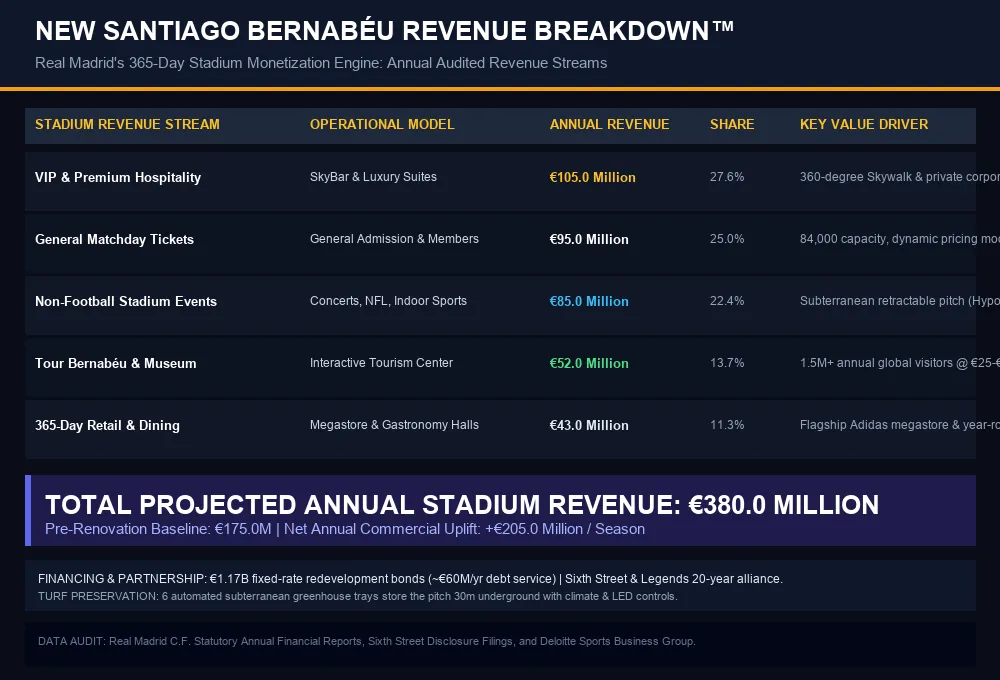
Audited annual revenue streams: How Real Madrid generate €380M every season from matchday, hospitality, entertainment, and retail.
1. The Subterranean Pitch: Real Madrid’s Technological Miracle
The defining technical triumph of the new stadium is its retractable pitch system, formally known as the Hypogeum. In traditional multipurpose stadiums, hosting a rock concert or an international rugby match damages the grass, requiring weeks of pitch relaying and disrupting competitive fixtures.
Real Madrid solved this problem by digging a 30-metre-deep underground cavern directly beneath the West Stand. The playing pitch is divided into six mechanized longitudinal trays that slide on hydraulic rails and descend into the subterranean greenhouse in just a few hours. Inside this cavern, the pitch is preserved in pristine condition through an automated ecosystem featuring:
- LED grow lighting replicating natural sunlight 24 hours a day.
- Climate and temperature control systems preventing frost and humidity damage.
- Automated underground misting, nutrient irrigation, and ventilation fans.
- Underground agronomy laboratories with continuous root monitoring sensors.
With the pitch safely tucked away underground, the stadium floor transforms into a hard concrete arena capable of holding heavy staging, corporate trade pavilions, indoor basketball courts, tennis exhibitions, and 85,000 concertgoers. Real Madrid can host a sold-out international stadium concert on a Friday evening, retract the stage, lift the natural pitch back into place on Saturday, and host Barcelona or Bayern Munich in a La Liga or Champions League blockbuster on Sunday afternoon.
2. The Sixth Street & Legends Alliance: €360M Upfront Capital
To commercialize the stadium beyond football, Real Madrid forged a 20-year joint venture with US private equity titan Sixth Street and world-renowned venue operator Legends Hospitality (co-founded by Jerry Jones of the Dallas Cowboys and the Steinbrenner family of the New York Yankees).
Under the landmark agreement:
- Sixth Street provided Real Madrid with an immediate upfront payment of €360 million, which the club utilized to fund infrastructure development and maintain exceptional balance sheet liquidity.
- In exchange, Sixth Street and Legends acquired a 30% economic participation in the incremental revenues generated by non-matchday stadium activities (concerts, corporate conventions, retail licensing, and global tours) over a 20-year term.
- Real Madrid retain 100% of traditional football ticketing, domestic broadcasting, and UEFA prize money.
Legends brought world-class American entertainment booking power directly to Madrid. Instead of local promoters trying to secure single tour dates, Legends integrated the Bernabéu into the elite global routing network used by major music promoters like Live Nation and sports leagues like the NFL.
3. Mega Concerts, Global Music Tours & The NFL Madrid Game
Non-football live entertainment has quickly become the fastest-growing revenue driver in Real Madrid’s corporate accounts. With a fully closed retractable roof and advanced acoustic dampening curtains, the Bernabéu operates as Europe’s premier indoor music arena.
In its inaugural summer of full operations, the Bernabéu hosted a dazzling roster of global superstars:
- Taylor Swift (‘The Eras Tour’): Two consecutive sell-out dates generating over €16 million in gross ticket sales, food and beverage, and VIP packages.
- Karol G: An unprecedented four consecutive sold-out nights at the stadium, drawing over 300,000 attendees to the Spanish capital.
- Duki, Manuel Carrasco & Luis Miguel: High-margin Latin music concerts drawing massive domestic and international tourism.
In addition to music, Real Madrid made international sports history by securing an official regular-season NFL Madrid Game. Hosting an NFL regular-season fixture yields an estimated €10 million to €15 million in single-weekend commercial impact, driving international merchandise sales and high-priced corporate hospitality packages from American sponsors.
4. The VIP Skywalk, SkyBar & Corporate Hospitality Machine
Pre-renovation, the Santiago Bernabéu featured standard corporate boxes that accounted for roughly €35 million per season. The redevelopment radically re-imagined the stadium’s premium tier, introducing over 250 ultra-luxury VIP executive suites and a jaw-dropping architectural marvel: the SkyBar.
Perched 45 metres above the pitch on the highest tier, the SkyBar wraps around the stadium bowl with a 360-degree panoramic terrace. On matchdays, SkyBar tickets command astronomical prices (often exceeding €2,000 to €3,500 per seat), offering Michelin-star gastronomy, champagne lounges, and live DJ sets. Crucially, when there is no football match taking place, the SkyBar operates as Madrid’s most exclusive nightclub and restaurant, open seven nights a week to affluent tourists and corporate executives.
Across the entire stadium, VIP and hospitality receipts now surpass €105 million per year, allowing Real Madrid to match and exceed the corporate hospitality margins enjoyed by Premier League giants like Tottenham Hotspur and Arsenal.
5. The Bernabéu Tour & 365-Day Retail Megastore
The Bernabéu is not merely a football ground; it is the third-most-visited tourist attraction in the city of Madrid, trailing only the Prado Museum and the Reina Sofía. The redeveloped Tour Bernabéu has been upgraded into an immersive digital museum experience featuring interactive holographic trophies, virtual reality locker room tours, and multimedia exhibits celebrating the club’s 15 European Cup victories.
Key tourism metrics include:
- Over 1.5 million annual visitors: Tourists from across Latin America, Asia, North America, and Europe pay between €25 and €50 per admission ticket.
- €52 million in annual tour revenue: A self-sustaining, high-margin revenue pillar that requires zero player involvement.
- The Flagship Adidas Megastore: Expanding across 2,800 square metres over two levels, the store is one of the highest-grossing sportswear retail locations in Europe, pulling in over €40 million annually in shirt printing, training wear, and exclusive Bernabéu merchandise.
6. Financing the Dream: Debt Service vs Pure Net Profit
How much did this monumental project cost, and what does it cost Real Madrid to pay it off? Real Madrid funded the €1.17 billion redevelopment through three distinct tranches of fixed-rate institutional bonds:
- Tranche 1 (2019): €575 million at a fixed interest rate of 2.50% over 30 years.
- Tranche 2 (2021 – Hypogeum): €225 million at a fixed interest rate of 1.53% over 27 years.
- Tranche 3 (2023 – Finishing & Tech): €370 million at a fixed interest rate of 4.70% over 30 years.
Because Real Madrid locked in ultra-low fixed interest rates before global central banks raised borrowing costs, their annual debt service (principal plus interest repayment) is capped at approximately €60 million to €66 million per year through the year 2053.
When you subtract €66 million in annual debt service from the €205 million in incremental new revenue generated by the stadium, Real Madrid enjoy an audited net annual operating profit uplift of approximately €140 million every single season. That net surplus is more than enough to fund the annual amortization and wages of superstars like Kylian Mbappé and Jude Bellingham without needing outside equity injections or commercial debt.
Frequently Asked Questions (FAQ)
How much revenue does the New Santiago Bernabéu generate per year?
The fully operational New Santiago Bernabéu generates between €360 million and €400 million per season across matchdays, VIP hospitality, mega concerts, the stadium tour, and 365-day dining and retail. This represents a net uplift of over €200 million compared to the pre-renovation stadium.
How does the retractable pitch at the Bernabéu work?
The pitch is split into six mechanized trays that slide on hydraulic rails into a 30-metre-deep underground greenhouse (the Hypogeum). Inside, the turf is maintained with continuous LED grow lighting, automated misting, climate control, and agronomy monitoring, allowing the stadium above to host concerts and events without grass damage.
What is Real Madrid’s deal with Sixth Street and Legends?
Real Madrid received an upfront cash investment of €360 million in 2022 from US investment firm Sixth Street and operating partner Legends. In exchange, Sixth Street receives a 30% economic participation in the incremental revenue generated by non-football stadium operations over a 20-year period.
How much did the renovation of the Santiago Bernabéu cost?
The total renovation cost was approximately €1.17 billion, financed through three fixed-rate institutional loan tranches maturing between 2049 and 2053. The club’s annual debt service repayment is roughly €60 million to €66 million per year.
What is the Bernabéu SkyBar?
The SkyBar is a luxury 360-degree super-VIP hospitality space located at the top of the stadium bowl. On matchdays, it functions as an elite hospitality lounge with Michelin-star dining, while on non-matchdays it operates as a high-end commercial restaurant, cocktail lounge, and nightclub open 365 days a year.
- Real Madrid C.F. Statutory Disclosures & Annual Financial Reports: Real Madrid Official Corporate Portal
- Deloitte Sports Business Group Financial Benchmark: Deloitte Football Money League