The €1 Billion Release Clause Club: Football’s Highest Buyout Clauses in 2026/27
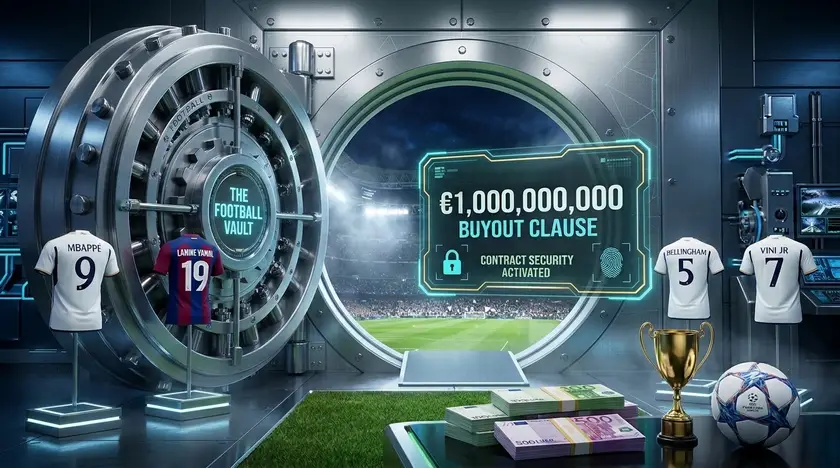
Short answer: The highest reported release clauses in football are €1,000,000,000, reported for eight players at Real Madrid and FC Barcelona, including Lamine Yamal, Kylian Mbappé and Jude Bellingham. Spanish law lets a player end his contract by paying the agreed compensation. The largest clause ever paid is Neymar’s €222 million in 2017.
Key Takeaways: The €1 Billion Buyout Club
- The €1 Billion Ceiling: The highest reported release clauses in football are €1,000,000,000, all at Real Madrid and FC Barcelona. We list eight current examples; Ferran Torres, Ansu Fati and Jules Koundé were also reported with €1 billion clauses as of April 2025.
- Spanish Royal Decree 1006/1985: Spanish law lets a player end his contract by paying compensation to his club. The amount is whatever the contract says; if no figure was agreed, a labour court sets it.
- Neymar’s €222 Million Precedent: Neymar’s €222 million clause, paid when he joined Paris Saint-Germain in August 2017, made him the most expensive player in history.
- Long Contracts: Lamine Yamal is under contract until June 2031, Kylian Mbappé until 2029, and Vinícius Júnior, after his August 2026 renewal, until June 2032.
In August 2017, Neymar’s representatives took a payment of €222 million to La Liga’s offices in Madrid to buy out his Barcelona contract. La Liga refused the deposit, so the money was paid at Barcelona’s offices in the player’s name, and Neymar joined Paris Saint-Germain. Until then, a €222 million buyout had looked like a number no club would ever pay.
It wasn’t.
Since then, Real Madrid and FC Barcelona have written far higher clauses into their stars’ contracts. With wealthy owners entering the transfer market—as detailed in our guide to the top 10 richest football club owners—a clause of €300 million or €400 million no longer looks out of reach.
The result is what we call The €1 Billion Buyout Club.
Below are the players with reported €1 billion release clauses in 2026/27, how a clause is triggered under Spanish law, and why such clauses are rare in the Premier League.
Which players have reported €1 billion release clauses in 2026/27?
The table lists eight players whose €1 billion release clauses have been reported, with their club and contract expiry. All eight clauses are the same size, so the order is not a ranking. Ferran Torres, Ansu Fati and Jules Koundé were also listed with €1 billion clauses as of April 2025. We could not confirm reported €1 billion figures for Federico Valverde or Ronald Araújo, who is on a season-long loan at Liverpool.
| Rank | Player | Club | Release Clause (€) | Contract Expiry | Contract Note |
|---|---|---|---|---|---|
| =1 | Lamine Yamal | FC Barcelona | €1,000,000,000 | June 2031 | Contract extended in May 2025 to 30 June 2031. |
| =1 | Kylian Mbappé | Real Madrid | €1,000,000,000 | June 2029 | Five-year contract, announced 3 June 2024. |
| =1 | Jude Bellingham | Real Madrid | €1,000,000,000 | June 2029 | Six-year contract, announced 14 June 2023. |
| =1 | Vinícius Júnior | Real Madrid | €1,000,000,000 (previous contract) | June 2032 | Renewed in August 2026 to June 2032; the clause in the new deal has not been reported. |
| =1 | Pedri | FC Barcelona | €1,000,000,000 | June 2030 | Contract extended in January 2025 to June 2030. |
| =1 | Gavi | FC Barcelona | €1,000,000,000 | June 2030 | 2022 Golden Boy; contract extended in January 2025 to 2030. |
| =1 | Eduardo Camavinga | Real Madrid | €1,000,000,000 | June 2029 | Contract extended in November 2023 to 30 June 2029. |
| =1 | Rodrygo | Real Madrid | €1,000,000,000 | June 2028 | Contract extended in November 2023 to 30 June 2028. |
Why Do Spanish Contracts Have Release Clauses?
Fans in England and Germany frequently wonder: “Why doesn’t Arsenal put a €1 billion clause on Bukayo Saka, or Manchester City on Erling Haaland?”
The answer lies in Spanish employment law rather than in club policy.
Under Real Decreto 1006/1985 of 26 June 1985, which governs the employment of professional athletes in Spain, a player can end his contract early, and his club is then entitled to compensation. Article 16.1 says the amount is whatever the two sides agreed; if there is no agreement, the labour courts set it, taking into account the sporting circumstances, the harm caused to the club and the reasons for the break.
Because a player can always leave on paying compensation, Spanish clubs fix the figure in the contract rather than leave it to a court, and the biggest clubs set it so high that it is very unlikely to be paid.
How does triggering a release clause work?
A buyout is not a normal transfer fee wired from one club to another.
Legally, it is the player ending his own contract. In outline:
- The Buying Club Advances the Money to the Player: The signing club does not pay the selling club directly; it advances the amount to the player.
- The Player Pays Through La Liga: The player, usually through his lawyers, pays the clause to his club via the league.
- The Contract Ends: Once the payment is made, the contract is terminated and the player is free to join his new club. In Neymar’s case La Liga refused the deposit, and his representatives paid Barcelona directly at the club’s offices.
Originally, the Spanish tax authorities treated the money advanced to the player as his taxable income, so the buying club also had to cover the income tax on it. Since October 2016 these advances are no longer taxed, so only the clause itself has to be paid. Any club paying €1 billion would still have to account for the cost under UEFA’s financial rules and its own league’s limits, such as La Liga squad cost limits.
Why do Premier League and Bundesliga clubs avoid buyout clauses?
Outside Spain, release clauses are not built into employment law in the same way. They exist only when a club agrees to one in contract talks.
In the Premier League, clubs generally avoid them because a fixed price takes bargaining power away from the selling club. When Manchester City signed Erling Haaland from Borussia Dortmund in 2022, the deal was reportedly done through a release clause in his Dortmund contract.
Without a release clause, the selling club sets the price—as West Ham did with Declan Rice and Brighton with Moisés Caicedo, both sold for a guaranteed £100 million plus add-ons—or simply refuses to sell.
Frequently Asked Questions (FAQ)
Who has the highest release clause in world football?
The highest reported release clauses are €1,000,000,000. Players reported with €1 billion clauses include Lamine Yamal, Pedri and Gavi at Barcelona and Kylian Mbappé, Jude Bellingham, Eduardo Camavinga and Rodrygo at Real Madrid. Vinícius Júnior’s previous contract also had a reported €1 billion clause; the figure in his August 2026 renewal has not been reported.
Can a club really pay a €1 billion release clause?
In principle, yes: Spanish law lets a player end his contract by paying the agreed compensation. In practice, no club has come close. The largest clause ever paid is Neymar’s €222 million in 2017, and a buying club would also have to account for the cost under UEFA’s Financial Sustainability Regulations and its own league’s spending rules.
Why are all €1 billion release clauses in Spain?
Spanish Royal Decree 1006/1985 (article 16) gives players the right to end their contracts on paying compensation to their club. Clubs fix that compensation in the contract, because otherwise a labour court would set it. Real Madrid and Barcelona set it at €1 billion for some of their most valuable players so that it is very unlikely to be paid.
What was the biggest release clause ever actually triggered?
Neymar’s €222 million clause, paid in his name to FC Barcelona in August 2017 when he joined Paris Saint-Germain. It made him the most expensive player in history.
Does Erling Haaland have a release clause?
His first Manchester City contract was reported to include release clauses. His extension to 2034, announced in January 2025, reportedly removed them. Unlike in Spain, release clauses in England are purely private contractual agreements and are not required by law.
How We Built This List & Sources
Clubs rarely publish release clauses, so the €1 billion values are as reported in the media and collected on Wikipedia’s release-clause page (status as of April 2025). Contract expiry dates come from the club announcements reported by the outlets below and were checked on 27 October 2026. We made no estimates of our own. The legal summary is based on the text of Royal Decree 1006/1985 as published in the BOE. Sources:
- BOE: Real Decreto 1006/1985, de 26 de junio (consolidated text) — article 16.1, compensation when a player ends his contract.
- Wikipedia: Release clause — players with reported €1 billion clauses (April 2025) and the 2016 change in tax treatment.
- ESPN: Vinícius Júnior renews with Real Madrid until June 2032 (7 August 2026)
- The Peninsula (AFP): Yamal signs new contract to 2031 (27 May 2025)
- beIN Sports: Inside Lamine Yamal’s contract extension (€1 billion clause)
- SuperSport: Pedri extends his Barcelona contract to June 2030 (30 January 2025)
- CBS Sports: La Liga refused the €222 million payment for Neymar, Barcelona did not (3 August 2017)
- Wikipedia player pages for contract dates: Kylian Mbappé, Jude Bellingham, Gavi, Eduardo Camavinga, Rodrygo, Federico Valverde and Ronald Araújo (loan to Liverpool).
- Africanews: Manchester City confirm Haaland’s extension to 2034 (17 January 2025)
- Wikipedia: List of most expensive association football transfers — Rice and Caicedo fees.