How Football Agents Are Paid: FIFA Commission Caps (3%-10%), Dual Representation & Transfer Realities

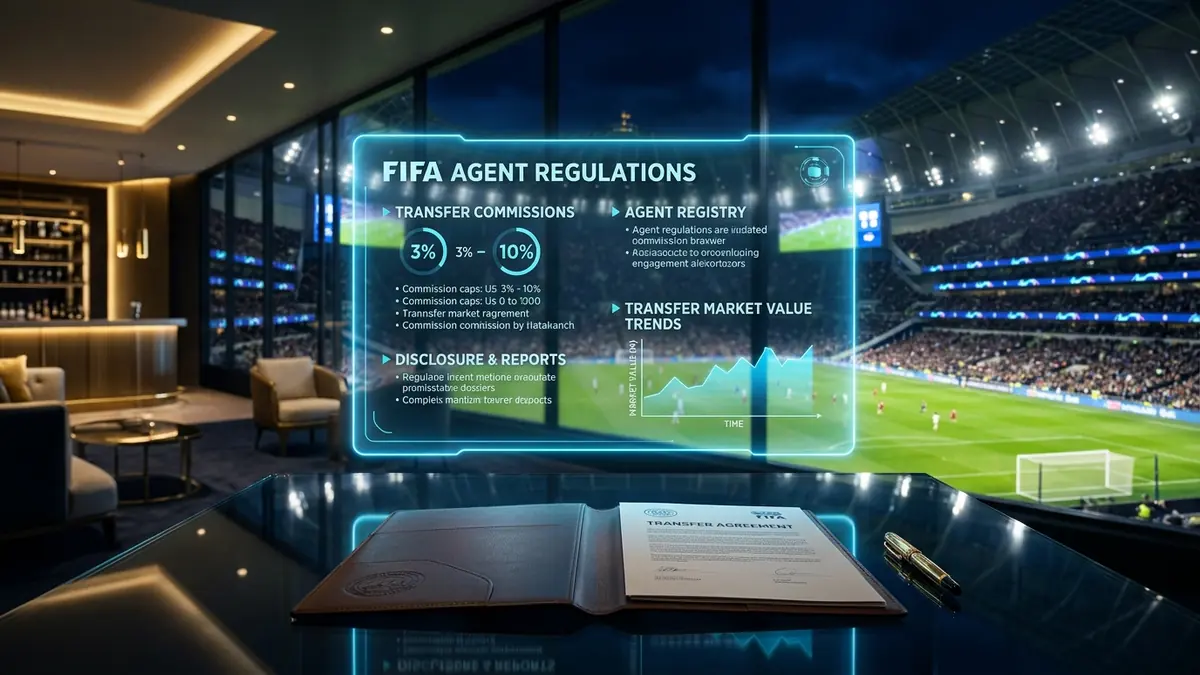
Short answer: Football agents typically earn 3% to 10% of a player’s gross annual salary, paid in biannual installments across the contract term, plus transaction fees on transfers. Under FIFA’s Football Agent Regulations (FFAR), commissions are capped between 3% and 5% of remuneration (or 10% on transfer fees for selling clubs), though major European legal challenges have led to temporary injunctions. Global intermediary fees paid by clubs exceeded $1 billion in 2026.
Transfer Fee Amortization, PSR & Squad Cost Ratio Calculator
Embed Transfer Amortization Calculator On Your Website
Select default club and currency to copy the shortcode for any transfer rumor or financial analysis post.
| Season / Yr | Fee Amort | Wage + Agent | Total P&L | End Book Value |
|---|
Every transfer window brings headlines detailing record-shattering transfer fees, but behind every blockbuster player movement is a network of licensed intermediaries, sports lawyers, and agency executives negotiating the transaction. Football agents are among the most influential figures in modern sports finance, orchestrating contract extensions, commercial endorsements, and international transfers.
Despite their prominence, how football agents actually get paid remains one of the most widely misunderstood aspects of the transfer market. This guide provides an authoritative breakdown of intermediary compensation structures, FIFA’s contested regulatory framework, the mechanics of dual representation, and why free-agent transfers frequently generate the largest agency commissions in the sport.
1. The Core Revenue Streams of Football Agents
Football intermediaries do not earn a flat salary; their earnings are derived entirely from performance-contingent commissions and service retainers across three primary streams:
- Player Playing Remuneration: The agent negotiates the player’s basic wage, signing bonus, and performance incentives with the club. The agent takes an agreed commission percentage (historically 5% to 10%, now targeted at 3% to 5% by FIFA) of the player’s gross salary for the duration of the playing contract.
- Transfer Compensation Fees: In major international transfers, agents may act on behalf of the releasing club or the buying club to broker the deal, earning an agreed commission percentage of the official transfer fee (typically 5% to 10%).
- Commercial Endorsements & Image Rights: Agencies negotiate off-pitch brand sponsorships (boot deals, fashion campaigns, beverage partnerships) and typically take a 15% to 20% commission on commercial gross revenues.
Crucially, an agent’s playing salary commission is not paid upfront in a single lump sum. Instead, it is disbursed in installments throughout the contract life, aligning with club payroll schedules. If a player signs a 5-year contract on £100,000 per week (£5.2m/year) with a 5% agent commission, the agency receives £260,000 annually, totaling £1.3m across the five seasons—provided the player remains under contract.
2. FIFA Football Agent Regulations (FFAR) & Fee Caps
To curb perceived financial excesses in the transfer market, FIFA introduced the FIFA Football Agent Regulations (FFAR), introducing mandatory licensing examinations, transparency clearing houses, and strict statutory service fee caps.
Under FIFA’s core regulatory framework, agent commissions are structured under the following statutory limits:
| Client Represented | Annual Player Remuneration ≤ $200k | Annual Player Remuneration > $200k |
|---|---|---|
| Individual Player | 5% of player remuneration | 3% of player remuneration |
| Engaging (Buying) Club | 5% of player remuneration | 3% of player remuneration |
| Dual Representation (Player + Buying Club) | 10% of player remuneration | 6% of player remuneration |
| Releasing (Selling) Club | 10% of transfer compensation | 10% of transfer compensation |
However, the implementation of these caps sparked immediate international litigation. Leading agency associations in England (AFA), Germany, and Spain challenged the fee caps under European Union and UK competition laws, arguing that mandatory commission limits constitute an unlawful collective restriction on trade.
In November 2023, an English arbitration tribunal ruled that the FFAR fee caps breached UK competition law. Similar injunctions followed in Germany. In response, FIFA officially suspended the worldwide enforcement of the fee cap rules pending a definitive ruling from the European Court of Justice (ECJ). Consequently, in major European leagues, agent fees continue to be determined by commercial negotiations between clubs, players, and agencies.
3. Official Intermediary Spending by League
According to FIFA’s annual Global Transfer Reports, international club spending on intermediary service fees has climbed steadily, surpassing $1 billion annually across global transactions. The English Premier League remains by far the highest-spending domestic competition for intermediary fees.
| League / Association | Annual Intermediary Spend () | Share of Global Agent Fees | Primary Market Driver |
|---|---|---|---|
| Premier League (England) | $485.4M | 46.2% | High broadcast revenue & squad turnover |
| Serie A (Italy) | $132.8M | 12.6% | Heavy reliance on loan-to-buy & free agent structures |
| Saudi Pro League (Saudi Arabia) | $118.5M | 11.3% | Aggressive sovereign wealth marquee recruitment |
| Bundesliga (Germany) | $89.2M | 8.5% | Outbound young talent sales & contract renewals |
| La Liga (Spain) | $74.6M | 7.1% | Strict LCPD spending caps restricting intermediary budgets |
| Ligue 1 (France) | $58.1M | 5.5% | Domestic talent exports to Premier League and Bundesliga |
4. How Dual Representation Really Works
One of the most distinctive features of European football transfers is dual representation. Under strict regulatory disclosure rules, an intermediary may represent both the buying club and the incoming player in the same transaction, provided both parties grant informed written consent.
From the club’s perspective, paying the intermediary to represent both parties provides significant tactical advantages:
- Unified Negotiation: The agent bridges personal contract terms and club transfer valuation simultaneously, expediting time-sensitive deadline-day agreements.
- Cash Flow Structuring: Rather than the player paying the agent directly from post-tax earnings, the club settles the agency invoices directly.
However, dual representation attracts heavy scrutiny from tax authorities. HM Revenue & Customs (HMRC) in the UK presumes that a significant portion of dual-representation payments represent a taxable benefit-in-kind conferred on the player, requiring clubs to account for 45% income tax and 13.8% employer National Insurance on the player’s behalf.
5. Why Free Transfers Yield the Biggest Agent Fees
It is a common misconception that agents make the most money when a record transfer fee is paid between clubs. In truth, top agencies frequently earn their largest single payouts when their elite clients run down their contracts and move on a free transfer (the Bosman ruling).
When a club signs a world-class player without paying a £80m or £100m transfer fee to a rival club, the buying club possesses substantial uncommitted capital. A significant portion of this saved transfer fee is redirected directly into:
- Astronomical Player Signing Bonuses: Often ranging from £20m to £50m paid across the contract term.
- Eight-Figure Agency Transaction Fees: Commission payments to the agent that would have otherwise gone to the selling club.
Prominent examples include Erling Haaland’s move to Manchester City, Kylian Mbappé’s transfer to Real Madrid, and Jude Bellingham’s transfer structure, where agency commissions represented significant multi-million-euro components of the overall package.
Frequently Asked Questions
What percentage do football agents take from player wages?
Historically, agents take between 5% and 10% of a player’s gross annual remuneration. While FIFA’s FFAR regulations aim to cap this figure at 3% for salaries exceeding $200,000, ongoing court injunctions in England and Europe mean commission rates are negotiated freely between the player and their agency.
Who pays the football agent—the player or the club?
In practice, the buying club pays the vast majority of agent fees directly. Under dual-representation agreements, the club pays the agent’s commission for negotiating the contract, although tax authorities treat the player’s portion as a taxable benefit-in-kind.
Can an agent represent both the selling club and the buying club?
No. FIFA regulations strictly prohibit “triple representation” or representing both the selling and buying club in the same transaction due to an irreconcilable conflict of interest. An agent may represent the player and the buying club, but cannot represent both clubs.
What qualifications are needed to become a licensed FIFA agent?
Under the revised FIFA framework, prospective agents must pass a rigorous 20-question FIFA licensing examination testing knowledge of transfer regulations, statutes, and dispute resolution systems, complete annual continuing professional development (CPD) hours, and clear a global criminal background check.