

Top 10 Most Followed Football Clubs on Facebook in 2026 (Updated)

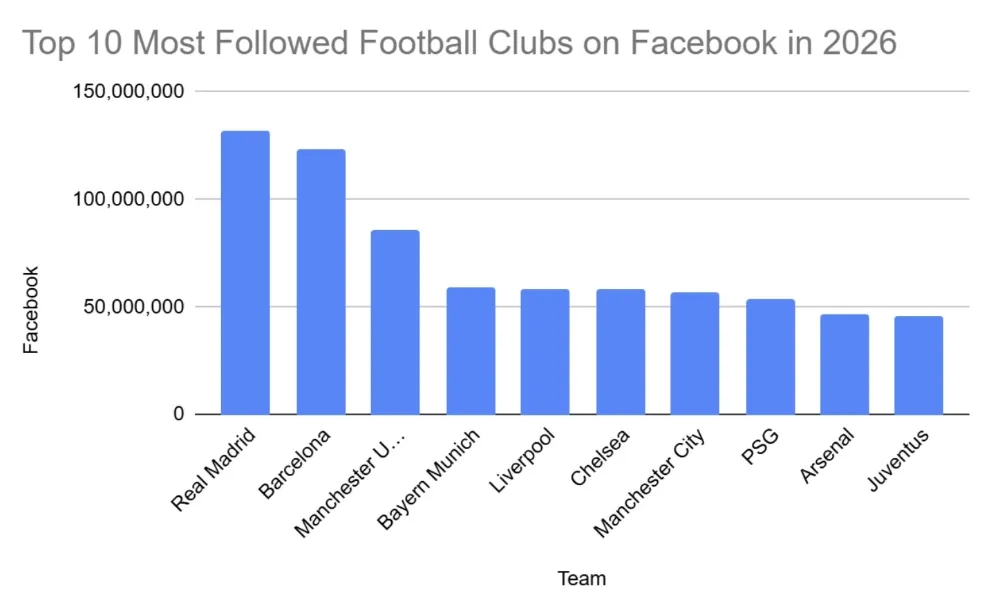
As the world’s most popular social networking site with over 3 billion users, Facebook remains a critical platform for football clubs to interact with their fans and build their global brand. In 2026, the most popular football club in the world, Real Madrid continues to dominate with 132 million Facebook followers, maintaining their position as the most-followed football club on the platform. Barcelona follows in second place with 123 million followers, while Manchester United holds strong at third with 86 million followers.

⚡ Tightest Battle: Liverpool and Chelsea are tied at exactly 58 million followers each, representing the closest competition in the entire top 10! Manchester City follows just 1 million behind at 57 million – positions #5, #6, and #7 could swap at any moment!

Which Football Club Has the Most Facebook Followers in 2026?

Real Madrid has the most Facebook followers among all football clubs in 2026, boasting 132 million followers. Like in 2023, 2024, and 2025, Real Madrid keeps dominating on Facebook, and close behind is only another Spanish club, Barcelona. This Spanish duopoly at the top of Facebook demonstrates the global appeal of La Liga’s two giants.

Real Madrid’s Facebook strategy leverages their 14 Champions League titles, global superstar roster, multi-language content, and historic legacy to engage fans across all continents. Their posts regularly generate millions of likes, comments, and shares, maintaining active engagement with their massive fanbase.
Top 10 Most Followed Football Clubs on Facebook in 2026_opt

Top 10 Most Followed Football Clubs on Facebook in 2026: The Complete List

1. Real Madrid

👍 132 million followers
Growth from 2025: +4 million followers (+3.1%)
League: La Liga (Spain)
Content Strategy: Multi-language posts, Champions League content, superstar features
Engagement Focus: Global fanbase across Europe, Latin America, Middle East, Asia
Average Post Reach: 2-5 million per major post

2. Barcelona

👍 123 million followers
Growth from 2025: +5 million followers (+4.2%)
Gap from #1: 9 million followers behind Real Madrid
League: La Liga (Spain)
Content Strategy: Artistic visuals, tactical content, La Masia academy features
Unique Strength: Strong visual identity, “Més que un club” philosophy

3. Manchester United

👍 86 million followers
Growth from 2025: +2 million followers (+2.4%)
League: Premier League (England)
Status: Most followed English club on Facebook
Content Strategy: Historic legacy, Old Trafford tradition, global fan engagement
Global Reach: Dominant presence in Asia, Africa, North America

4. Bayern Munich

👍 59 million followers
Growth from 2025: -3 million followers (-4.8%)
Position Stable: Maintained 4th position despite slight decline
League: Bundesliga (Germany)
Content Strategy: German efficiency, Bundesliga dominance, Champions League pedigree
Note: Only top 10 club with negative growth in 2026

5. Liverpool

👍 58 million followers
Growth from 2025: +7 million followers (+13.7%)
Big Jump: Rose from 8th to 5th position (+3 positions!)
League: Premier League (England)
Content Strategy: Emotional storytelling, Anfield atmosphere, “You’ll Never Walk Alone”
Growth Driver: Highest percentage growth in top 10
Tight Race: Tied with Chelsea at exactly 58M

6. Chelsea

👍 58 million followers
Growth from 2025: +2 million followers (+3.6%)
Position Change: Dropped from 5th to 6th (-1 position)
League: Premier League (England)
Content Strategy: London lifestyle, youth development, new ownership era
Tight Race: Tied with Liverpool at exactly 58M

7. Manchester City

👍 57 million followers
Growth from 2025: +3 million followers (+5.6%)
Position Change: Dropped from 6th to 7th (-1 position)
League: Premier League (England)
Content Strategy: Trophy celebrations, Pep Guardiola tactics, Champions League winners
Close Race: Only 1M behind Liverpool/Chelsea

8. PSG

👍 54 million followers
Growth from 2025: +2 million followers (+3.8%)
Position Change: Dropped from 7th to 8th (-1 position)
League: Ligue 1 (France)
Content Strategy: Fashion-forward content, Paris culture, entertainment crossover
Unique Strength: Celebrity and influencer engagement

9. Arsenal

👍 47 million followers
Growth from 2025: +3 million followers (+6.8%)
Position Change: Rose from 10th to 9th (+1 position)
League: Premier League (England)
Content Strategy: Young attacking football, North London culture, title challenge momentum
Growth Driver: On-field success under Arteta driving social media growth

10. Juventus

👍 46 million followers
Growth from 2025: -1 million followers (-2.1%)
Position Change: Dropped from 9th to 10th (-1 position)
League: Serie A (Italy)
Content Strategy: Bold design, Italian football culture, black-and-white brand
Note: Second club with negative growth (after Bayern Munich)

Quick Rankings Overview

Rank Club Facebook Followers 2025 Rank Change
1 Real Madrid 132M 1st
2 Barcelona 123M 2nd
3 Manchester United 86M 3rd
4 Bayern Munich 59M 4th
5 Liverpool 58M 8th ⬆️ +3
6 Chelsea 58M 5th ⬇️ -1
7 Manchester City 57M 6th ⬇️ -1
8 PSG 54M 7th ⬇️ -1
9 Arsenal 47M 10th ⬆️ +1
10 Juventus 46M 9th ⬇️ -1

2025 vs 2026: Year-Over-Year Analysis

Major Position Changes

Biggest Mover:

⬆️ Liverpool: Jumped from 8th to 5th (+3 positions, +13.7% growth)
Other Position Changes:
⬆️ Arsenal: Rose from 10th to 9th (+1 position, +6.8% growth)
⬇️ Chelsea: Fell from 5th to 6th (-1 position)
⬇️ Manchester City: Dropped from 6th to 7th (-1 position)
⬇️ PSG: Fell from 7th to 8th (-1 position)
⬇️ Juventus: Dropped from 9th to 10th (-1 position)
Stable Positions:
Top 4 unchanged: Real Madrid, Barcelona, Manchester United, Bayern Munich

Total Follower Count Comparison

Club 2025 Followers 2026 Followers Growth % Change
Real Madrid 128,000,000 132,000,000 +4,000,000 +3.1%
Barcelona 118,000,000 123,000,000 +5,000,000 +4.2%
Manchester United 84,000,000 86,000,000 +2,000,000 +2.4%
Bayern Munich 62,000,000 59,000,000 -3,000,000 -4.8%
Liverpool 51,000,000 58,000,000 +7,000,000 +13.7%
Chelsea 56,000,000 58,000,000 +2,000,000 +3.6%
Manchester City 54,000,000 57,000,000 +3,000,000 +5.6%
PSG 52,000,000 54,000,000 +2,000,000 +3.8%
Arsenal 44,000,000 47,000,000 +3,000,000 +6.8%
Juventus 47,000,000 46,000,000 -1,000,000 -2.1%

Growth Champions & Decline Alert

📈 Highest Growth (Percentage):
🥇 Liverpool: +13.7% (+7M followers)
🥈 Arsenal: +6.8% (+3M followers)
🥉 Manchester City: +5.6% (+3M followers)
4️⃣ Barcelona: +4.2% (+5M followers)
5️⃣ PSG: +3.8% (+2M followers)
📈 Highest Growth (Absolute Numbers):
🥇 Liverpool: +7 million followers
🥈 Barcelona: +5 million followers
🥉 Real Madrid: +4 million followers
📉 Negative Growth:
⚠️ Bayern Munich: -4.8% (-3M followers) – Biggest decline
⚠️ Juventus: -2.1% (-1M followers)
Key Insight: Liverpool’s 13.7% growth is exceptional, nearly double the growth rate of any other top 10 club. Bayern Munich and Juventus are the only clubs experiencing follower decline, possibly due to on-field struggles or reduced social media investment.

Head-to-Head Comparisons

El Clásico: Real Madrid vs Barcelona

Real Madrid: 132 million followers
Barcelona: 123 million followers
Difference: Real Madrid leads by 9 million (7.3% more)
Analysis: The gap has narrowed from 10M in 2025 to 9M in 2026, as Barcelona grew faster (+4.2%) than Real Madrid (+3.1%). At this rate, Barcelona could close the gap within 2-3 years.

The Three-Way Tie: Liverpool, Chelsea, Manchester City

Liverpool: 58 million followers (#5)
Chelsea: 58 million followers (#6)
Manchester City: 57 million followers (#7)
Gap: Only 1 million separates #5 and #7!
⚡ Volatile Battle: These three positions are the most volatile in the top 10. Liverpool’s momentum (+13.7% growth) could pull them away, or City’s Champions League success could propel them forward. Chelsea is caught in the middle with solid but unspectacular growth. Expect these positions to shuffle monthly!

Manchester Derby on Facebook

Manchester United: 86M (#3 overall)
Manchester City: 57M (#7 overall)
Gap: United leads by 29 million followers (50.9% more)
Analysis: Despite City’s on-field dominance in recent years, Manchester United’s global brand from the Ferguson era and massive international fanbase (especially in Asia and Africa) maintains a commanding Facebook advantage. This gap is unlikely to close significantly in the near term.

League Representation Analysis

Which Countries Have the Most Football Clubs in Facebook’s Top 10?

League Breakdown:

Premier League (England): 5 clubs – Manchester United, Liverpool, Chelsea, Manchester City, Arsenal
La Liga (Spain): 2 clubs – Real Madrid, Barcelona
Bundesliga (Germany): 1 club – Bayern Munich
Serie A (Italy): 1 club – Juventus
Ligue 1 (France): 1 club – PSG
Key Insight: English clubs make up half of the top 10, reflecting the Premier League’s massive global broadcasting reach and international fanbase. However, Spanish clubs dominate the top 2 positions with a combined 255 million followers (more than all 5 Premier League clubs combined at 306M).

Total Followers by League

Premier League: 306M total (5 clubs) – 61.2M average per club
La Liga: 255M total (2 clubs) – 127.5M average per club
Bundesliga: 59M total (1 club)
Serie A: 46M total (1 club)
Ligue 1: 54M total (1 club)
Dominance: La Liga has fewer clubs but more than double the average followers per club compared to the Premier League, thanks to Real Madrid and Barcelona’s unparalleled global appeal.

Why Facebook Still Matters for Football Clubs

Facebook’s Unique Advantages

Despite the rise of TikTok, Instagram, and other platforms, Facebook remains critical for football clubs:

  • Largest user base: Over 3 billion monthly active users globally
  • Older demographics: Reaches fans aged 25-65 with higher purchasing power
  • Community features: Fan groups, events, watch parties, discussions
  • Long-form content: Detailed posts, articles, match reports, tactical analysis
  • Video platform: Facebook Watch for full match highlights and exclusive content
  • Advertising power: Precise targeting for ticket sales, merchandise, subscriptions
  • Global reach: Dominant in markets like India, Southeast Asia, parts of Latin America

Facebook vs Other Platforms

Platform Leadership Comparison:

Instagram: Real Madrid (180M) – Best for visual content, younger audience
TikTok: Real Madrid (70M) – Best for viral moments, Gen Z reach
YouTube: Barcelona (25.1M) – Best for long-form video, educational content
Facebook: Real Madrid (132M) – Best for community building, older fans, global reach
Strategy: Smart clubs don’t choose one platform – they maintain strong presence across all major platforms with tailored content strategies for each audience.

Frequently Asked Questions

Which football club has the most Facebook followers in 2026?

Real Madrid has the most Facebook followers among football clubs in 2026, with 132 million followers on the platform. This represents a growth of 4 million followers from 2025 (128M).

What are the top 3 football clubs on Facebook in 2026?

The top 3 football clubs on Facebook in 2026 are: 1) Real Madrid with 132 million followers, 2) Barcelona with 123 million followers, and 3) Manchester United with 86 million followers. Spanish clubs dominate the top 2 positions.

How many Premier League clubs are in the Facebook top 10?

Five Premier League clubs are in the Facebook top 10 in 2026: Manchester United (#3), Liverpool (#5), Chelsea (#6), Manchester City (#7), and Arsenal (#9). This represents half of the top 10 positions.

What is the gap between Real Madrid and Barcelona on Facebook?

Real Madrid leads Barcelona by 9 million Facebook followers (132M vs 123M) in 2026. Despite this gap, Barcelona remains the only club close to Real Madrid’s Facebook dominance, and the gap is narrowing as Barcelona grows faster.

Which clubs are in the tightest race on Facebook?

Liverpool and Chelsea are tied at exactly 58 million Facebook followers each, representing the tightest race in the entire top 10. Manchester City follows just 1 million behind at 57 million followers, making positions #5-7 extremely volatile.

What major position changes happened in 2026?

Liverpool had the biggest jump, rising from 8th to 5th place (+3 positions) with 13.7% growth. Arsenal climbed from 10th to 9th. Chelsea, Manchester City, PSG, and Juventus all dropped one position each. The top 4 positions remained unchanged.

Why does Real Madrid dominate Facebook?

Real Madrid dominates Facebook through their global brand recognition built over decades, 14 Champions League titles providing endless legacy content, star-studded roster driving engagement, multi-language content strategy reaching all continents, and consistent fan interaction across time zones.

Conclusion

Football clubs have huge followings on Facebook in 2026, with Real Madrid leading at 132 million fans. Barcelona and Manchester United follow in second and third place, maintaining the same top 3 as in previous years. The Spanish duopoly of Real Madrid and Barcelona continues to dominate the summit with a combined 255 million followers.

English clubs make up half of the top 10, reflecting the Premier League’s massive global reach and international broadcasting power. However, the most dramatic story of 2026 is Liverpool’s surge – jumping from 8th to 5th with 13.7% growth, the highest in the top 10.

Two clubs experienced negative growth: Bayern Munich (-4.8%) and Juventus (-2.1%), suggesting potential issues with social media strategy or declining on-field performance impacting fan engagement.

Social media numbers show how strong global fan support really is, with the top 10 clubs collectively commanding 720 million Facebook followers – nearly 10% of Facebook’s entire user base following just ten football clubs!

👍 Which of these giants do you support? Share your thoughts and let us know if you’re surprised by any positions on this list!

Data Source & Methodology

All Facebook follower counts were collected from official verified club Facebook pages as of January 25, 2026. Historical comparison data from 2025 is used for year-over-year growth analysis.

Data Collection:

✓ Source: Official Facebook pages
✓ Date: January 25, 2026
✓ Verification: All pages are verified with blue checkmarks
✓ Previous Data: 2025 for year-over-year comparison
✓ Original Publication: March 5, 2023