All 18 Bundesliga Clubs Ranked by Staff Costs (2026/27 Clubs, Latest Accounts)
Short answer: Bayern Munich have the highest staff costs in the Bundesliga, at €443.5 million in 2024/25, followed by Borussia Dortmund (€268.3 million) and RB Leipzig (€208.9 million). SV Elversberg are lowest of the 18 clubs of 2026/27 at €14.7 million. The DFL figures cover all employees, not only players.
Bundesliga Staff Costs: Key Takeaways
- Bayern Munich’s Dominance: Bayern’s staff costs of €443.5 million (2024/25) are more than the bottom eight clubs’ combined (€402.5M) and 1.65 times Dortmund’s (€268.3M).
- The Harry Kane Disparity: Harry Kane’s estimated gross salary of about €25 million is more than the total staff costs of promoted SV Elversberg (€14.7M) or SC Paderborn (€17.0M) in their last 2. Bundesliga financial year.
- The 50+1 Rule: Club members must keep a majority of voting rights, which stops outside investors from taking control. Bayer Leverkusen, owned by Bayer AG, is a long-standing exception.
- Early Over-Achievers: SC Freiburg (ninth-highest staff costs, €83.1M) are third after seven matchdays, and newcomers SV Elversberg, with the lowest costs (€14.7M), are eighth.
German football is famous for packed terraces, 50+1 fan ownership, cheap match tickets, and world-class atmospheres. But beneath the roaring Yellow Wall of Dortmund and the red glow of the Allianz Arena lies one of the most tightly regulated, and most top-heavy, financial systems in European football.
While several Premier League clubs are owned by state funds and private equity, the German Football League (DFL) puts every club through an annual licensing process, and clubs that can’t prove their finances can be refused a licence. Yet despite this caution, the spending gap at the top of German football is huge.
No Bundesliga club publishes its first-team wage bill. The closest official figure is total staff costs (Personalaufwand), which the DFL publishes for every licensed club from its latest annual accounts. Below, we rank the 18 clubs in the 2026/27 Bundesliga by that figure. It covers all employees, not just players, and the promoted clubs’ numbers come from their last season in the 2. Bundesliga.
Which Bundesliga clubs have the highest staff costs?
The table ranks all 18 clubs in the 2026/27 Bundesliga by total staff costs as published by the DFL on 28 May 2026. Each figure comes from the club’s latest financial year (2024/25, or calendar year 2025 where the club reports that way). Positions are as of 25 October 2026, after seven matchdays.
| Rank | Club | Total Staff Costs (€, DFL) | Financial Year | Position After 7 Matchdays | Context |
|---|---|---|---|---|---|
| 1 | FC Bayern Munich | €443,476,000 | 2024/25 (group) | 1st (17 pts) | Group revenue of €978.3M in 2024/25; Bundesliga champions in 2025/26. |
| 2 | Borussia Dortmund | €268,296,000 | 2024/25 | 2nd (17 pts) | Stock-market listed club. |
| 3 | RB Leipzig | €208,943,000 | 2024/25 | 5th (12 pts) | Red Bull-backed club. |
| 4 | Bayer 04 Leverkusen | €207,487,000 | Calendar 2025 | 4th (13 pts) | Owned by Bayer AG under a long-standing exemption from the 50+1 rule. |
| 5 | Eintracht Frankfurt | €177,300,000 | 2024/25 | 14th (8 pts) | Known for big player sales, such as Kolo Muani to PSG in 2023. |
| 6 | VfB Stuttgart | €163,850,000 | Calendar 2025 | 15th (6 pts) | Porsche holds a minority stake in the club’s football company. |
| 7 | TSG 1899 Hoffenheim | €94,871,000 | 2024/25 | 10th (9 pts) | Back under 50+1 after Dietmar Hopp handed back majority voting rights in 2023. |
| 8 | Borussia Mönchengladbach | €94,603,000 | Calendar 2025 | 18th (3 pts) | Bottom of the table after seven matchdays. |
| 9 | SC Freiburg | €83,116,000 | 2024/25 | 3rd (13 pts) | Playing at the Europa-Park Stadion since 2021. |
| 10 | 1. FC Union Berlin | €79,841,000 | 2024/25 | 17th (6 pts) | Champions League participants in 2023/24. |
| 11 | SV Werder Bremen | €74,580,000 | 2024/25 | 6th (12 pts) | Founding member of the Bundesliga in 1963. |
| 12 | 1. FSV Mainz 05 | €73,004,000 | 2024/25 | 7th (10 pts) | In the Bundesliga every season since 2009/10. |
| 13 | FC Augsburg | €61,528,000 | 2024/25 | 9th (9 pts) | American minority investment. |
| 14 | FC Schalke 04 | €58,974,000 | 2024/25 (2. Bundesliga) | 16th (6 pts) | Promoted in 2026. |
| 15 | 1. FC Köln | €55,939,000 | 2024/25 (2. Bundesliga) | 12th (8 pts) | Promoted in 2025. |
| 16 | Hamburger SV | €46,816,000 | 2024/25 (2. Bundesliga) | 11th (9 pts) | Promoted in 2025. |
| 17 | SC Paderborn 07 | €16,981,000 | 2024/25 (2. Bundesliga) | 13th (8 pts) | Promoted in 2026 after beating Wolfsburg in the play-off. |
| 18 | SV 07 Elversberg | €14,673,000 | Calendar 2025 (2. Bundesliga) | 8th (10 pts) | First Bundesliga season in the club’s history. |
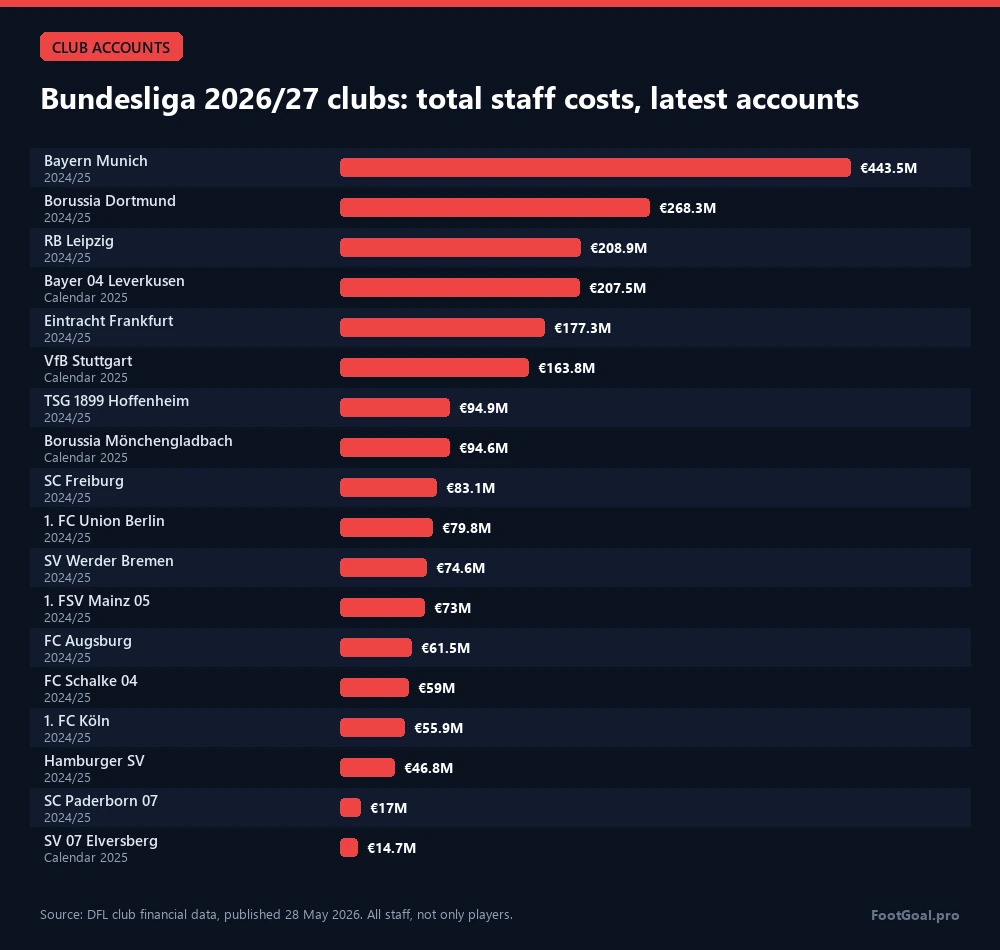
Bundesliga 2026/27 clubs: total staff costs, latest accounts. Source: DFL club financial data, published 28 May 2026. All staff, not only players.
How big is Bayern Munich’s spending gap over the rest of the Bundesliga?
To understand why Bayern Munich have won 11 of the last 12 Bundesliga titles (every one since 2014/15 except Leverkusen’s in 2023/24), you don’t need a tactical whiteboard—you just need a calculator.
Bayern’s staff costs of €443.5 million in 2024/25 were 1.65 times those of Borussia Dortmund (€268.3M) and more than double RB Leipzig’s (€208.9M) and Bayer Leverkusen’s (€207.5M). Bayern alone account for about 20% of the €2.22 billion spent on staff by the 18 clubs, more than the bottom eight clubs combined.
Here is why Bayern’s financial lead is virtually unassailable:
- Record Revenue: Bayern’s group revenue reached a record €978.3 million in 2024/25, backed by long-term partners such as Allianz, Adidas and Telekom.
- Superstar Wage Brackets: Salary estimates put Harry Kane at about €25M gross a year, Jamal Musiala at €23–25M and Joshua Kimmich at about €20M. Dortmund’s best-paid players are estimated at €9–10M. Bayern doesn’t publish salaries, so these are estimates.
- Profitability: Despite those costs, Bayern reported a 2024/25 pre-tax profit of €42.5 million and EBITDA of €187.8 million.
How does the 50+1 rule shape German football finance?
Why doesn’t a tech billionaire buy Hamburger SV or Schalke 04 and spend €200 million on players? The answer is the 50+1 Rule (50+1-Regel).
Under DFL regulations, a commercial investor cannot own more than 49% of the voting shares in a German football club. The club’s registered members (the fans) must always retain at least 50% plus one additional vote. This creates two distinct realities:
- The Blessing: Outside owners can’t load clubs with takeover debt, ticket prices stay low by English standards, and members have a direct vote in how their club is run.
- The Curse: Clubs can’t raise hundreds of millions from outside investors to compete with Bayern or Premier League giants, so their wage bills depend largely on the commercial and matchday revenue they earn themselves.
Which Bundesliga clubs are over-achieving on small budgets?
If Bayern Munich represent corporate football royalty, SC Freiburg and newcomers SV Elversberg show what smaller budgets can do.
SV Elversberg, in their first Bundesliga season, reported staff costs of €14.7 million for 2025, when they were still in the 2. Bundesliga. That is about a thirtieth of Bayern’s figure, yet after seven matchdays they are eighth with 10 points.
SC Freiburg (€83.1M, the ninth-highest staff costs) are third with 13 points, level with Bayer Leverkusen, whose staff costs (€207.5M) are 2.5 times higher.
Frequently Asked Questions (FAQ)
Which Bundesliga club has the highest staff costs?
FC Bayern Munich, by a wide margin: total staff costs of €443.5 million in the 2024/25 group accounts, as published by the DFL. That is 1.65 times Borussia Dortmund’s €268.3 million. The figure covers all staff; salary estimates put the first-team squad’s base pay at roughly €220–245 million.
Who is the highest-paid player in the Bundesliga?
Harry Kane is estimated to be the highest-paid player in the Bundesliga, on a gross base salary of about €25 million a year (roughly €480,000 a week) at FC Bayern Munich. Bayern doesn’t publish salaries, so this is an estimate.
What is the 50+1 rule in the Bundesliga?
The 50+1 rule is a regulation by the Deutsche Fußball Liga (DFL) stipulating that club members (the fans) must retain a majority of the voting rights (50% plus one vote) in the commercial entity that runs the football team. It prevents external commercial investors from taking complete control of German clubs.
Which club has the lowest staff costs in the Bundesliga?
Promoted SV Elversberg have the lowest staff costs, €14.7 million for 2025, followed by SC Paderborn (€17.0 million for 2024/25). Both figures come from seasons in the 2. Bundesliga. Of the clubs that were in the Bundesliga in 2024/25, FC Augsburg’s €61.5 million is the lowest.
How do Bundesliga clubs afford lower wage bills than the Premier League?
Revenue is the main reason. The 20 Premier League clubs paid about £4.4 billion in wages in 2024/25, while the 18 current Bundesliga clubs’ total staff costs come to about €2.22 billion. The DFL’s annual licensing checks and the 50+1 rule also mean German clubs can’t rely on wealthy outside owners to cover losses.
Method & Sources
What the table shows: total staff costs (Personalaufwand) from each club’s latest annual accounts, as published by the DFL on 28 May 2026: the 2024/25 financial year, or calendar year 2025 for clubs that report that way. These include all employees (coaches and other staff as well as players), so they are not first-team wage bills, and Bayern’s is a group figure. Shares, ratios and ‘bottom eight’ totals are our calculations. Player salaries (Kane, Musiala, Kimmich, Dortmund’s top earners and Bayern’s squad base pay) are published estimates, not official figures. Positions are as of 25 October 2026. Sources:
- DFL: Finanzkennzahlen, Clubs der Bundesliga 2026-2027 (PDF) — total staff costs for all 18 clubs.
- DFL: Finanzkennzahlen der Proficlubs (28 May 2026) — publication date and the financial years covered.
- echo24: FC Bayern 2024/25 results (3 November 2025) — Bayern’s €978.3M revenue, €187.8M EBITDA and €42.5M pre-tax profit.
- buli-tipphilfe.de: Bundesliga salaries 2026/27 (12 October 2026) — estimated player salaries and Bayern squad base pay.
- Wikipedia: 2026–27 Bundesliga — the 18 clubs and the table after seven matchdays.
- Wikipedia: 2025–26 Bundesliga — Bayern’s 2025/26 title and the relegation of Wolfsburg, Heidenheim and St. Pauli.
- Matchday Finance: Premier League financial results 2024/25 — Premier League wages of £4.4bn.