

FootGoal La Liga Economic Index™: Key 2026/27 Takeaways
- The €750 Million Hegemony: Real Madrid commands a historic official spending limit of €754.89 million—more than the combined total of the bottom 16 La Liga clubs put together (€745.2M).
- Barcelona’s Rebuilding Surge: After hitting rock bottom with a negative limit in 2022, FC Barcelona’s cap climbed back to €426.43 million, paving the way back toward the coveted 1:1 spending rule with the Spotify Camp Nou return and new Nike agreement.
- The Sevilla Catastrophe: In the most shocking financial collapse in modern Spanish football history, Sevilla FC plummeted from a €168M limit down to just €2.50 million—the lowest in the entire division—following European elimination and disastrous severance packages.
- The Basque Financial Fortress: Real Sociedad (€159.26M) and Athletic Club (€100.82M) boast the most sustainable balance sheets in Spain, operating with zero external debt and positive transfer amortizations.
Every summer transfer deadline in Spain feels less like football and more like an episode of Succession. While English clubs splash £100 million on impulse buys and Italian clubs play chess with loan-to-buy clauses, Spanish sporting directors spend August sweating in air-conditioned offices, refreshing spreadsheets to see if La Liga president Javier Tebas will let them register their backup left-back.
Welcome to the world of the Límite de Coste de Plantilla Deportiva (LCPD)—commonly known to fans as La Liga’s official squad spending cap. Unlike UEFA’s Financial Fair Play or the Premier League‘s PSR, which slap clubs with fines or point deductions after the money is already spent, Spain’s financial system is an ex-ante gatekeeper. If your payroll exceeds your official cap by a single euro, the league’s registration software physically blocks you from submitting a player license.
To give you the complete picture of Spanish football’s financial reality, FootGoal analyzed the official published spending caps issued by La Liga for all 20 clubs. Here is the full verified ranking, the mechanics of how the numbers are calculated, and what it means on the pitch.
All 20 La Liga Clubs Ranked by Spending Cap (LCPD)
The table below details every club’s official spending limit, their weekly squad payroll ceiling, their regulatory registration status under La Liga rules, and their primary financial catalyst.
| Rank | Club | Official Cap (€) | Weekly Ceiling | Spending Status | Financial Catalyst / Context |
|---|---|---|---|---|---|
| 1 | Real Madrid | €754,894,000 | €14,517,192 | 1:1 Compliant | Bernabéu 365-day events, Champions League titles & zero structural debt. |
| 2 | FC Barcelona | €426,427,000 | €8,200,519 | Restricted (1:1 Target) | Wage bill reduced by €180M; Camp Nou return & Nike extension crucial. |
| 3 | Atlético de Madrid | €310,745,000 | €5,975,865 | 1:1 Compliant | Riyadh Air sponsorship, capital increase & steady Champions League earnings. |
| 4 | Real Sociedad | €159,259,000 | €3,062,673 | 1:1 Compliant | Massive player trading profits (Mikel Merino, Le Normand) + European prize money. |
| 5 | Villarreal CF | €135,860,000 | €2,612,692 | 1:1 Compliant | Smart academy-to-first-team pipeline funded by Roig ceramic manufacturing backing. |
| 6 | Real Betis | €108,990,000 | €2,095,961 | 1:1 Compliant | 55,000+ season ticket sellouts; Benito Villamarín redevelopment underway. |
| 7 | Athletic Club | €100,818,000 | €1,938,807 | 1:1 Compliant | Unique Basque-only policy means zero transfer amortization; €100M+ in cash reserves. |
| 8 | Girona FC | €94,464,000 | €1,816,615 | 1:1 Compliant | Champions League qualification and City Football Group commercial synergies. |
| 9 | RC Celta de Vigo | €77,570,000 | €1,491,730 | 1:1 Compliant | Prudent wage control under Marián Mouriño, clearing legacy wages. |
| 10 | Valencia CF | €74,608,000 | €1,434,769 | 1:1 Compliant | Strict Peter Lim austerity; lowest average squad age in Europe’s top leagues. |
| 11 | RCD Mallorca | €58,841,000 | €1,131,557 | 1:1 Compliant | American ownership stability, Copa del Rey final run bonus, stadium overhaul. |
| 12 | CA Osasuna | €51,862,000 | €997,346 | 1:1 Compliant | Fan-owned club model; disciplined El Sadar matchday revenue generation. |
| 13 | Rayo Vallecano | €45,371,000 | €872,519 | 1:1 Compliant | Working-class Madrid identity; tight wage scales with modest facilities. |
| 14 | Real Valladolid | €41,836,000 | €804,538 | 1:1 Compliant | Ronaldo Nazário ownership; promotion bonus offset by strict wage caps. |
| 15 | UD Las Palmas | €40,320,000 | €775,384 | 1:1 Compliant | Island travel logistics balance; focus on free transfers and loanees. |
| 16 | Getafe CF | €39,172,000 | €753,307 | Restricted (Article 100) | Angel Torres operating on thin margins; repeatedly near squad cap ceiling. |
| 17 | Deportivo Alavés | €38,628,000 | €742,846 | 1:1 Compliant | Grupo Baskonia-Alavés multi-sport synergy; tight wage brackets. |
| 18 | CD Leganés | €37,138,000 | €714,192 | 1:1 Compliant | Blue Crow Sports Group ownership; Segunda promotion budget normalization. |
| 19 | RCD Espanyol | €8,789,000 | €169,019 | Severe Deficit (Article 100) | Rastar Group funding freeze; legacy contracts from relegation forced severe cap slash. |
| 20 | Sevilla FC | €2,499,000 | €48,057 | Historic Emergency Deficit | Down from €168M in 2023. Missing Europe, high manager payoffs & multi-year contract deadweight. |
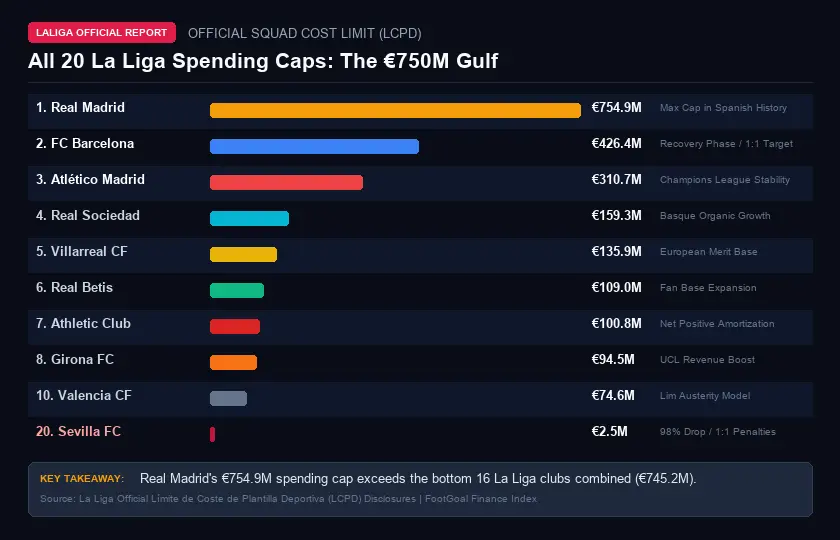
Figure 1: Official La Liga squad cost limits across all tiers. Real Madrid (€754.9M) commands more spending capacity than the bottom 16 clubs combined.
How La Liga’s Spending Cap Actually Works (The Math Behind the Limit)
Fans often ask: “Does La Liga pick a random number to penalize Barcelona or protect Real Madrid?”
The answer is no. Unlike the NBA or NFL, where the salary cap is a fixed uniform number negotiated via a collective bargaining agreement ($140.5M for every team), La Liga’s Límite de Coste de Plantilla Deportiva is calculated individually for every single club using an audited mathematical formula:
Here is what counts toward the cap:
- Player and Coaching Salaries: Fixed base salaries, appearance fees, and guaranteed contract loyalty bonuses for the entire first team and coaching staff.
- Transfer Fee Amortization: The transfer fee divided across the contract length. If a club buys a player for €50 million on a five-year deal, exactly €10 million per year counts against the spending cap.
- Agent Commissions and Social Security: All intermediary fees, legal costs, image rights licensing, and mandatory employer state contributions.
- Filial (Reserve & Academy) Squad: Reserve team player contracts (e.g., Real Madrid Castilla, Barça Atlètic) count against the total ceiling.
Why Real Madrid’s Cap Is an Untouchable €754.9 Million
Real Madrid’s spending limit (€754.89M) is the highest ever recorded in the history of Spanish football. To put that in perspective, Real Madrid’s legal spending capacity is larger than the total spending limits of the bottom 16 La Liga clubs combined (€745.2M).
How did Florentino Pérez build this financial juggernaut?
- The 365-Day Santiago Bernabéu Stadium Engine: The €1.2 billion stadium renovation featuring the retractable pitch and roof transforms the stadium into a year-round entertainment venue, hosting NFL games, international concerts (Taylor Swift, Karol G), corporate conventions, and VIP hospitality, boosting annual commercial revenue past €1.07 billion.
- Zero Bank Debt for Operations: Real Madrid’s structural net debt is negative (cash reserves exceed financial obligations), meaning the club pays negligible debt servicing penalties under La Liga’s formula.
- Low Amortization Overhead: By signing elite superstars like Kylian Mbappé, Antonio Rüdiger, and David Alaba as free agents, Real Madrid pays higher wages but incurs €0 in transfer amortization. That keeps their annual cap balance sheets remarkably clean.
Barcelona’s Long Road Back to the 1:1 Rule
In 2022, FC Barcelona shocked world football when La Liga revealed the club was operating with a negative spending cap (−€144M). That forced club president Joan Laporta to pull his famous “palancas” (financial levers), selling off future TV rights and Barça Studios equity to register signings.
Fast forward to the 2026/27 campaign, and Barcelona’s official cap has surged back to €426.43 million. That is an astonishing recovery of over €570 million in legal headroom. But the battle is not over:
Under La Liga regulations, clubs who spend above their assigned cap are placed under Article 100 restrictions (the famous 1:4 rule). When restricted, a club cannot freely spend €100 from player sales. Instead, they can only reinvest 50% or 60% of any salary savings generated into new player registrations. Returning to the unrestricted 1:1 rule requires closing the structural budget gap permanently, primarily driven by returning to a 105,000-capacity Spotify Camp Nou and signing the landmark €1.7 billion Nike kit renewal.
The Sevilla FC Shock: How a Giant Sunk to €2.5 Million
The most shocking headline of the official report is Sevilla FC sitting at #20 with a spending cap of just €2,499,000. Just three seasons ago, Sevilla’s cap stood at €168 million.
How does a seven-time UEFA Europa League champion end up with a spending cap smaller than half the Segunda División?
- The Champions League Cliff: Consecutive mid-table finishes stripped Sevilla of €70M+ in recurring annual UEFA broadcast and prize revenue.
- Monchi-Era Aging High Earners: Sevilla remained locked into massive, unshiftable multi-year contracts handed to aging stars whose amortizations and wages smothered the balance sheet.
- Managerial Severance Carousel: Paying out multi-million euro severance packages to Julen Lopetegui, Jorge Sampaoli, José Luis Mendilibar, and Diego Alonso was classified as immediate structural losses under La Liga’s audit rules.
Because their actual payroll is roughly €100 million while their legal cap is €2.5 million, Sevilla is in extreme excess. Every transfer window requires shedding players or using personal board bank guarantees just to register emergency loanees.
Frequently Asked Questions (FAQ)
What is La Liga’s Límite de Coste de Plantilla Deportiva (LCPD)?
The LCPD is the maximum amount of money a Spanish club is legally authorized to spend on its sporting squad during a season. It covers first-team player wages, manager and coaching salaries, agent commissions, transfer fee amortizations, and reserve squad contracts.
What happens if a La Liga club exceeds its spending cap?
Unlike the Premier League where clubs receive point deductions after the season ends, La Liga prevents excess spending in real time. Clubs over the cap cannot register new players unless they operate under restricted rules (the 50%/60% rule), meaning they must generate €100 in wage savings or transfer profits to spend €50 or €60 on a new player.
What is the difference between the 1:1 rule and the 1:4 rule?
Under the normal 1:1 rule, a club whose payroll is within its official cap can spend every single euro (€1 for €1) of revenue or transfer sales on new player contracts. Under the 1:4 (or modern 60%) rule, clubs over their cap can only reinvest a fraction of their savings into incoming registrations.
Can La Liga clubs increase their spending cap during the winter transfer window?
Yes. La Liga publishes updated spending caps twice every season: once in September following the summer transfer window, and once in February following the winter window. Clubs can increase their limit mid-season by securing new commercial sponsorship agreements, selling players for unexpected profits, or executing an approved capital increase.
Does transfer debt count against La Liga’s salary cap?
Yes. Transfer fee amortization is a core pillar of the cap calculation. Additionally, any structural debt repayments due within the current fiscal year are subtracted directly from budgeted operating revenue before the spending ceiling is established.
Official Financial Data & Regulatory Sources
The official spending limits (Límite de Coste de Plantilla Deportiva) and regulatory compliance data in this report were verified directly from official Spanish sports regulatory publications:
- LALIGA Official Límite de Coste de Plantilla Deportiva (LCPD) Disclosures — Official published spending ceilings, Article 100 registration criteria, and Economic Control Committee rulings.
- Real Madrid CF Official Audited Annual Accounts — Audited financial reports, Bernabéu stadium operating income, and net equity reserves presented to club socio delegates.