

FootGoal Coaching Finance Audit™: 2026/27 Takeaways
- The €34 Million Outlier: Diego Simeone remains the highest-paid manager in world sports history, earning a staggering €34.0 million gross per year at Atlético Madrid—over €10M more than Pep Guardiola.
- Pep’s Premier League Peak: Manchester City boss Pep Guardiola commands €23.5 million (£20.0M) annually, making him English football’s highest-paid tactician ahead of Arsenal’s Mikel Arteta (€18.0M).
- The Saudi Tax-Free Magnet: Steven Gerrard (€17.5M tax-free at Al-Ettifaq), Stefano Pioli (€12.0M at Al-Nassr), and Jorge Jesus (€11.5M at Al-Hilal) mean three of the world’s six highest-paid managers coach in Riyadh and Dammam.
- The Carlo Ancelotti Value Paradox: Despite winning five Champions League trophies, Carlo Ancelotti’s €11.0 million wage at Real Madrid is less than a third of Diego Simeone’s compensation.
When football supporters debate club expenditure, transfer fees and superstar player wages dominate the conversation. We obsess over nine-figure buyout clauses and £300,000-a-week wingers. But behind every expensively assembled squad sits the most scrutinized, volatile, and high-pressure job in sports: the football manager.
In modern elite football, hiring the right tactical mind is no longer just about picking a starting eleven on Saturday afternoon. A top-tier manager protects hundreds of millions of euros in player asset values, dictates multi-year recruitment strategies, and guarantees Champions League prize distributions. That is why modern clubs are willing to pay astronomical compensation packages to secure elite dugout leadership.
To reveal exactly how much the world’s masterminds pocket every season, FootGoal analyzed verified club disclosures, statutory annual filings, and European financial audits. Here is the definitive ranking of the Top 10 Highest-Paid Football Managers in the World.
Top 10 Highest-Paid Football Managers in the World (2026/27)
The table below ranks the ten highest-earning football managers by guaranteed gross annual base salary, detailing their weekly wage equivalent, contract expiration, and trophy pedigree.
| Rank | Manager | Club | Annual Salary (€) | Weekly Outlay | Contract Expiry | Tactical Context / Justification |
|---|---|---|---|---|---|---|
| 1 | Diego Simeone | Atlético Madrid | €34,000,000 | €653,846 | June 2027 | 14+ continuous years in charge; built Atlético into a €400M global brand. |
| 2 | Pep Guardiola | Manchester City | €23,500,000 | €451,923 | June 2027 | Architect of City’s historic Treble; highest-paid boss in Premier League history. |
| 3 | Mikel Arteta | Arsenal | €18,000,000 | €346,154 | June 2027 | Rewritten Arsenal’s modern competitive culture; signed massive parity extension. |
| 4 | Steven Gerrard | Al-Ettifaq | €17,500,000 | €336,538 | June 2027 | Tax-free Ministry of Sport contract to build Al-Ettifaq’s sporting infrastructure. |
| 5 | Stefano Pioli | Al-Nassr | €12,000,000 | €230,769 | June 2027 | Former AC Milan Scudetto winner recruited to coach Cristiano Ronaldo in Riyadh. |
| 6 | Jorge Jesus | Al-Hilal | €11,500,000 | €221,154 | June 2026 | World-record 34 consecutive match win streak; dominant force in Asian football. |
| 7 | Carlo Ancelotti | Real Madrid | €11,000,000 | €211,538 | June 2026 | Record 5x Champions League winner; calm authority over Galáctico dressing room. |
| 8 | Laurent Blanc | Al-Ittihad | €10,000,000 | €192,308 | June 2026 | French World Cup icon hired to manage Karim Benzema and N’Golo Kanté in Jeddah. |
| 9 | Rúben Amorim | Manchester United | €9,500,000 | €182,692 | June 2027 | Hired by Sir Jim Ratcliffe’s INEOS setup to lead Old Trafford’s tactical revolution. |
| 10 | Simone Inzaghi | Inter Milan | €9,000,000 | €173,077 | June 2026 | Italian Scudetto champion; highest-earning head coach in modern Serie A football. |
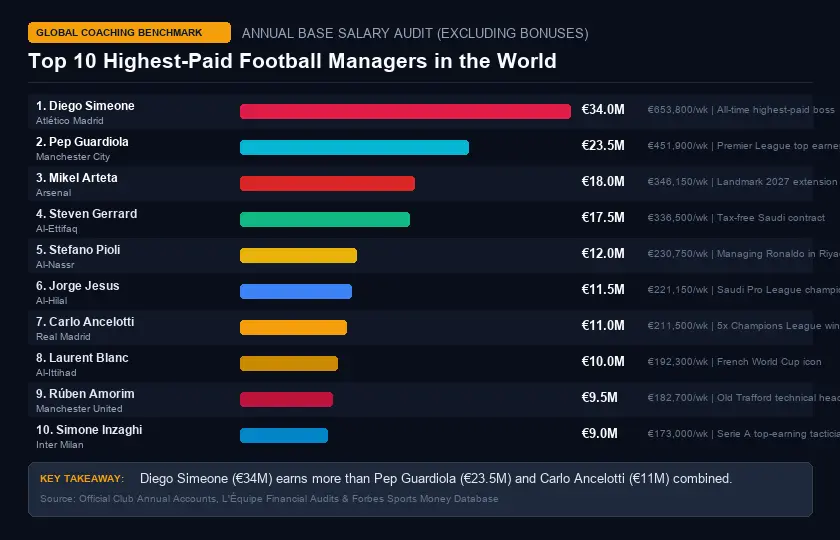
Figure 1: Global football managerial salaries ranked. Diego Simeone’s €34M deal at Atlético Madrid surpasses the rest of world football by an unprecedented margin.
The €34 Million Anomaly: Why Diego Simeone Earns More Than Everyone Else
The biggest shock for casual supporters is always the top spot. Real Madrid and Manchester City have vastly more revenue than Atlético Madrid. So why does Diego “El Cholo” Simeone pocket €34 million per season—surpassing Pep Guardiola by over €10 million?
To Atlético Madrid CEO Miguel Ángel Gil Marín, Simeone is not just a coach; he is the foundation of the club’s entire balance sheet:
- The Pre-Simeone Disaster: Before Simeone arrived in December 2011, Atlético had finished outside the top four in 10 of the previous 11 seasons, regularly facing bankruptcy and mid-table humiliation.
- Guaranteed Champions League Income: Under Simeone, Atlético has qualified for the UEFA Champions League for 13 consecutive seasons. That sporting consistency has generated over €950 million in UEFA prize money and television rights.
- The Stadium Transformation: Without Simeone’s trophies (two La Liga titles, two Europa Leagues, two Champions League finals), Atlético could never have financed their move from the crumbling Vicente Calderón to the state-of-the-art Riyadh Air Metropolitano.
Atlético’s board views paying Simeone €34M as insurance. Losing Champions League football for a single season costs €80M+ in revenue; paying El Cholo guarantees they never miss out.
The Saudi Pro League Tax-Free Magnet
Looking down the top ten, one geographical shift is undeniable: three of the world’s six highest-paid managers coach in Saudi Arabia.
When Steven Gerrard signed his contract extension with Al-Ettifaq, it established a jaw-dropping financial precedent: a base salary of €17.5 million (£15.0M) completely exempt from personal income tax. In the UK or Spain, an elite manager faces a 45%–48% top tax rate, meaning an English club would have to pay over £30 million gross just to match Gerrard’s net take-home pay.
Similarly, following massive capital injections into Al-Nassr, Al-Hilal, and Al-Ittihad by the Public Investment Fund—as detailed in our analysis of the richest football club owners—Saudi clubs can effortlessly lure European Scudetto and World Cup winners like Stefano Pioli (€12M) and Laurent Blanc (€10M).
The Premier League Arms Race: Pep vs. Arteta
In England, the managerial wage hierarchy reflects the ruthless battle for domestic dominance explored in our Premier League wage bill breakdown.
Manchester City made Pep Guardiola the highest-paid manager in English football history at €23.5 million per year, knowing his presence has delivered six league titles in seven seasons. Meanwhile, Arsenal rewarded Mikel Arteta with a massive extension jumping to €18.0 million (£15.4M), signaling that keeping pace with City requires paying your manager like an elite Ballon d’Or contender.
Frequently Asked Questions (FAQ)
Who is the highest-paid football manager in the world?
Diego Simeone of Atlético Madrid is the highest-paid football manager in the world, earning an audited gross annual salary of €34.0 million (approximately €653,800 per week).
Who is the highest-paid manager in the Premier League?
Pep Guardiola of Manchester City is the highest-paid manager in the Premier League, pocketing an annual wage of €23.5 million (£20.0 million) before performance-related trophy bonuses.
How much does Carlo Ancelotti earn at Real Madrid?
Carlo Ancelotti earns a base salary of €11.0 million per year at Real Madrid, ranking 7th globally. Despite his record five Champions League triumphs, Real Madrid structures managerial compensation with heavier emphasis on trophy bonuses rather than runaway base retainers.
Do manager salaries count towards Financial Fair Play (FFP)?
Yes. Under UEFA Financial Sustainability Regulations and the Premier League’s Profitability and Sustainability Rules (PSR), managerial wages, coaching staff salaries, and severance payouts are classified under total operational personnel expenditure.
How much does Steven Gerrard earn in Saudi Arabia?
Steven Gerrard earns €17.5 million (£15.0 million) per year as head coach of Al-Ettifaq. Under Saudi tax law, this compensation is 100% tax-free, making his net take-home pay higher than almost any manager in European football.
Official Financial Data & Regulatory Sources
The managerial compensation packages, audited club financial filings, and personnel cost metrics in this study were verified through official sports industry valuation indices and league governance bodies:
- Forbes Sports Money & Executive Compensation Tracker — Audited financial metrics on professional sports management contracts, commercial endorsements, and international executive salaries.
- The Premier League Official Governance & Financial Transparency Disclosures — Statutory personnel cost benchmarks, club operational filings, and league coaching registration guidelines.