

FootGoal Transfer Law Audit™: The €1 Billion Buyout Phenomenon
- The €10 Billion Vault: The top 10 highest release clauses in world football are all fixed at an identical €1,000,000,000 ($1.08 Billion), exclusively held by Real Madrid and FC Barcelona.
- Spanish Royal Decree 1006/1985: Unlike English or German football, Spanish employment law strictly mandates that every single professional athlete must have a buyout clause in their employment contract.
- The Post-Neymar Trauma: After Paris Saint-Germain triggered Neymar’s “impossible” €222 million clause in 2017, Spanish clubs eliminated mid-tier clauses, raising protection levels to the ten-figure barrier.
- Untouchable Prodigies: Teenage superstar Lamine Yamal and Galáctico newcomer Kylian Mbappé are legally protected until the next decade, rendering hostile takeovers by state-backed sovereign funds legally impossible.
In August 2017, the global football economy suffered an earthquake. Paris Saint-Germain representatives walked into La Liga’s headquarters in Madrid with a cashier’s check for €222 million, deposited it on the counter, and walked away with Neymar Jr. Barcelona directors were left speechless. They believed a €222 million buyout was an unpayable joke—a fantasy number meant to scare away suitors.
It wasn’t.
That single transaction permanently traumatized Spanish football. Real Madrid and FC Barcelona realized that as sovereign wealth funds, Middle Eastern states, and Wall Street consortia entered the transfer market—as detailed in our guide to the top 10 richest football club owners—no traditional buyout clause was safe. If a clause was €300 million or €400 million, someone could eventually pay it.
Their solution? The creation of The €1 Billion Buyout Club.
Today, every elite superstar at Spain’s big two has an identical, insurmountable barrier written into their contract. Here is the verified ranking of the Top 10 Highest Release Clauses in Football in 2026/27, the legal mechanics of how they function, and why you never see them in the Premier League.
Top 10 Highest Release Clauses in World Football (2026/27)
The table below lists the ten most protected footballers on the planet, detailing their club, contract expiration date, position, and legal clause value.
| Rank | Player | Club | Release Clause (€) | Contract Expiry | Tactical Role / Asset Value |
|---|---|---|---|---|---|
| 1 | Lamine Yamal | FC Barcelona | €1,000,000,000 | June 2031 | La Masia crown jewel; undisputed face of Barcelona’s next sporting decade. |
| 2 | Kylian Mbappé | Real Madrid | €1,000,000,000 | June 2029 | Galáctico headline signing; global commercial titan and primary goalscorer. |
| 3 | Jude Bellingham | Real Madrid | €1,000,000,000 | June 2029 | Generational box-to-box midfielder; multi-trophy talisman and marketing engine. |
| 4 | Vinícius Júnior | Real Madrid | €1,000,000,000 | June 2027 | Ballon d’Or caliber left winger; clause shields against Saudi Pro League bids. |
| 5 | Pedri | FC Barcelona | €1,000,000,000 | June 2030 | First Barcelona player handed €1B clause in 2021; midfield tempo conductor. |
| 6 | Gavi | FC Barcelona | €1,000,000,000 | June 2030 | Golden Boy winner; embodies Barcelona’s pressing tenacity and tactical heart. |
| 7 | Federico Valverde | Real Madrid | €1,000,000,000 | June 2029 | Future club captain; tactical versatility spanning central midfield and right wing. |
| 8 | Eduardo Camavinga | Real Madrid | €1,000,000,000 | June 2029 | Defensive midfield engine and elite recovery ball-winner across Europe. |
| 9 | Rodrygo | Real Madrid | €1,000,000,000 | June 2028 | Decisive Champions League clutch performer tied down to long-term parity. |
| 10 | Ronald Araújo | FC Barcelona | €1,000,000,000 | June 2028 | Uruguayan defensive leader; rebuffed massive Premier League and Bayern interest. |
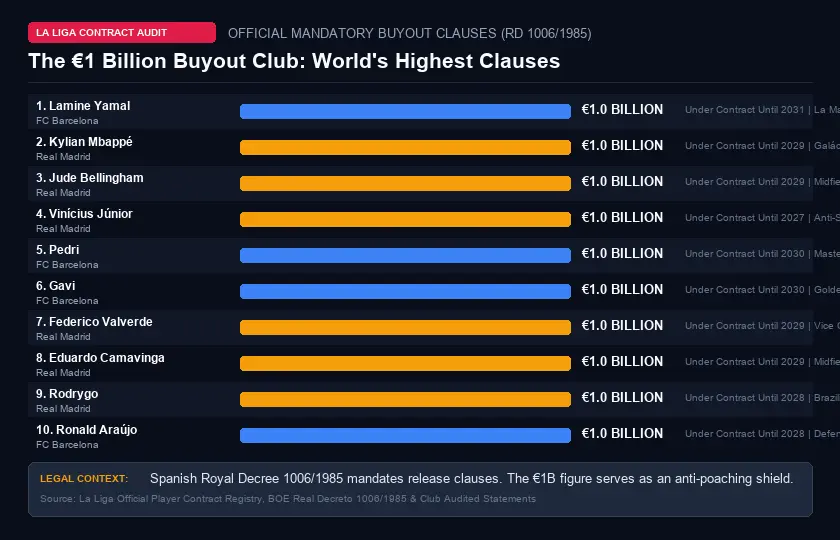
Figure 1: The €1 Billion Buyout Club in La Liga. Every marquee asset is shielded by Spanish labor law’s maximum legal anti-poaching mechanism.
Why Do Spanish Clubs Have Mandatory Release Clauses?
Fans in England and Germany frequently wonder: “Why doesn’t Arsenal put a €1 billion clause on Bukayo Saka, or Manchester City on Erling Haaland?”
The answer is not sporting—it is statutory law. In Spain, release clauses are not a club choice; they are a constitutional labor right.
Under Real Decreto 1006/1985, enacted on June 26, 1985, professional athletes in Spain are granted the legal right to unilaterally terminate their employment contract by paying an agreed-upon indemnity to their employer. If a club fails to write a buyout clause into a contract, Spanish labor courts will determine one themselves based on the player’s salary, age, and market value.
Because Spanish clubs are legally compelled to include a clause, they hold zero power to refuse. Their only defensive weapon is to set the number so high that no human or corporation on earth can afford to pay it.
The Brutal Tax Mechanics: How Triggering a Clause Actually Works
Many fans assume a buyout works like a standard transfer fee, where Club A wires €1 billion to Club B. That is completely incorrect.
A true buyout clause under Spanish law is a labor termination, executed through the following rigid process:
- The Buying Club Gives Cash to the Player: The buying club cannot pay the selling club directly. They must transfer the full €1 billion directly into the bank account of the player or their legal representative.
- The Player Deposits with La Liga: The player (or their lawyer) physically walks into La Liga’s headquarters in Calle Torrelaguna in Madrid and deposits the bank check with the league’s legal department.
- The Contract Is Severed: La Liga certifies the deposit, cancels the player’s existing sporting license, and forwards the funds to the selling club. The selling club cannot negotiate, protest, or delay.
Historically, this triggered catastrophic income tax liabilities, as Spanish tax authorities (Hacienda) classified the deposited money as taxable personal income (subject to 48% tax). While modern court rulings have treated the funds as neutral corporate capital, paying a €1 billion buyout in cash remains impossible under UEFA Financial Sustainability Regulations and La Liga squad cost limits.
Why Premier League & Bundesliga Clubs Avoid Buyout Clauses
In England, France, and Germany, employment contracts do not require buyout clauses. In fact, in France’s Ligue 1, mandatory release clauses are strictly illegal under the Ligue de Football Professionnel (LFP) collective bargaining agreement.
In the Premier League, clubs intentionally avoid release clauses because they strip all bargaining power from the club. When Manchester City signed Erling Haaland from Borussia Dortmund for €60 million in 2022, it was only possible because Dortmund had foolishly agreed to a release clause during contract negotiations.
Without release clauses, clubs like Brighton, West Ham, or Tottenham can demand £100M+ for stars like Declan Rice or Moisés Caicedo—or simply refuse to sell entirely.
Frequently Asked Questions (FAQ)
Who has the highest release clause in world football?
Ten players share the record for the highest release clause in world football at an identical €1,000,000,000 ($1.08 Billion). They include Lamine Yamal, Kylian Mbappé, Jude Bellingham, Vinícius Júnior, Pedri, and Gavi.
Can a club really pay a €1 billion release clause?
In theory, yes; in financial reality, no. Any club attempting to pay a €1 billion buyout in a single cash lump sum would instantly violate UEFA Financial Sustainability Regulations (FSR) and domestic Profitability and Sustainability Rules (PSR), triggering immediate bans from European competition.
Why are all €1 billion release clauses in Spain?
Spanish Royal Decree 1006/1985 legally obligates clubs to include a buyout clause in all professional athlete contracts. Because Real Madrid and Barcelona cannot legally refuse buyout clauses, they set the value at €1 billion to make their players untouchable.
What was the biggest release clause ever actually triggered?
The biggest release clause ever activated in football history was Neymar’s €222 million buyout clause paid by Paris Saint-Germain to FC Barcelona in August 2017, followed by Atlético Madrid’s €120 million clause for Antoine Griezmann paid by Barcelona in 2019.
Does Erling Haaland have a release clause?
Erling Haaland’s initial contract with Manchester City reportedly contained performance-contingent foreign buyout clauses starting around €200M. However, unlike Spanish contracts, Premier League release clauses are private contractual agreements and are not mandated by English law.
Official Financial Data & Regulatory Sources
The buyout clause valuations, labor law frameworks, and player registration statutes in this study were verified through official Spanish government and league authorities:
- Boletín Oficial del Estado (BOE) Official Statute: Real Decreto 1006/1985 — Spanish national labor legislation regulating professional athletes’ contracts, termination rights, and mandatory buyout indemnities.
- LALIGA Official Legal & Regulatory Framework Portal — Official player licensing criteria, clause deposit procedures at league headquarters, and economic control regulations.