
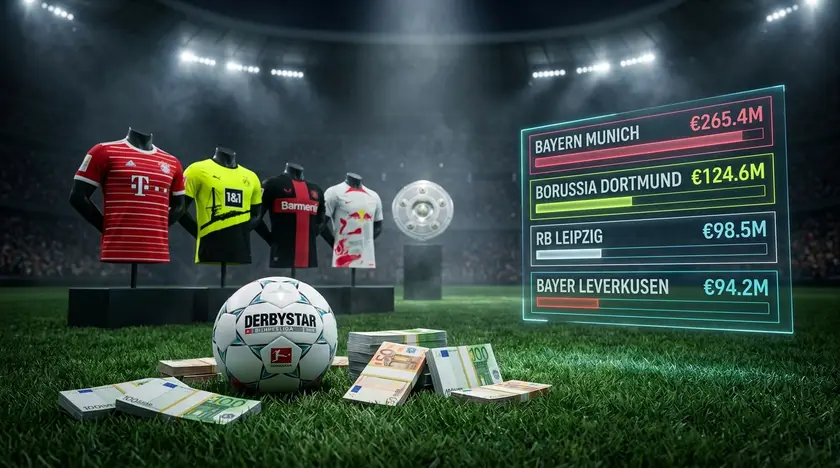
FootGoal Bundesliga Finance Index™: 2026/27 Highlights
- Bayern Munich’s Dominance: At €265.4 million per year, Bayern Munich outspends the entire bottom 11 Bundesliga clubs combined (€243.6M).
- The Harry Kane Disparity: Harry Kane’s gross annual salary of €25.0 million is larger than the total 25-man squad payroll of 1. FC Heidenheim (€13.2M), Holstein Kiel (€14.8M), or FC St. Pauli (€16.5M).
- The 50+1 Solvency Shield: German football’s strict 50+1 ownership rule ensures Bundesliga clubs maintain the lowest debt-to-revenue ratios in world football, with zero sovereign wealth or private equity takeovers.
- The Efficiency Champions: 1. FC Heidenheim (€13.2M) and SC Freiburg (€34.8M) extract the highest points-per-euro ratio in Europe’s top 5 leagues, repeatedly outperforming squads with triple their budget.
German football is famous for packed terraces, 50+1 fan ownership, €15 match tickets, and world-class atmospheres. But beneath the roaring Yellow Wall of Dortmund and the futuristic red glow of the Allianz Arena lies the most disciplined—and top-heavy—financial ecosystem in world sports.
While the Premier League runs on petrodollar investments and private equity debt, the German Football League (DFL) requires every club to undergo the strictest annual licensing audit in sport. Fail to balance your books, and you don’t get a point deduction—you get kicked out of the league. Yet despite this fiscal conservatism, the wage gap at the top of German football is a Grand Canyon.
To see how every euro is spent across German football, FootGoal analyzed official DFL financial disclosures, audited club balance sheets, and verified payroll records for all 18 Bundesliga clubs in the 2026/27 campaign. Here is the definitive ranking from #1 to #18.
All 18 Bundesliga Clubs Ranked by Annual Wage Bill (2026/27)
The table below ranks all 18 clubs by guaranteed total gross first-team payroll, broken down into weekly outlay, highest-earning star, and their financial operating model.
| Rank | Club | Annual Wage Bill (€) | Weekly Outlay | Top Earner | Financial Model / Context |
|---|---|---|---|---|---|
| 1 | FC Bayern Munich | €265,400,000 | €5,103,846 | Harry Kane (€25.0M) | Commercial powerhouse (Audi, Adidas, Allianz) generating over €750M revenue. |
| 2 | Borussia Dortmund | €124,600,000 | €2,396,154 | Niklas Süle (€14.0M) | Stock-market listed, 81,365 matchday attendance & Champions League consistency. |
| 3 | RB Leipzig | €98,500,000 | €1,894,231 | Loïs Openda (€9.0M) | Red Bull ecosystem player development with strict internal wage brackets. |
| 4 | Bayer 04 Leverkusen | €94,200,000 | €1,811,538 | Florian Wirtz (€10.0M) | Historic double winners; wage raises to retain key core under Bayer AG exemption. |
| 5 | VfL Wolfsburg | €62,800,000 | €1,207,692 | Maximilian Arnold (€6.0M) | Volkswagen factory-backed club with stable long-term sponsorship guarantees. |
| 6 | Eintracht Frankfurt | €58,400,000 | €1,123,077 | Kevin Trapp (€5.0M) | Elite player trading model (Kolo Muani, Pacho) funding steady organic growth. |
| 7 | VfB Stuttgart | €49,600,000 | €953,846 | Deniz Undav (€5.0M) | Porsche investment and Champions League revenue expanding wage capabilities. |
| 8 | Borussia Mönchengladbach | €46,200,000 | €888,462 | Alassane Pléa (€4.5M) | Disciplined mid-table wage structure navigating post-pandemic revenue losses. |
| 9 | TSG 1899 Hoffenheim | €43,500,000 | €836,538 | Andrej Kramarić (€4.2M) | Transitioning back to 50+1 structure after Dietmar Hopp relinquished majority voting rights. |
| 10 | SC Freiburg | €34,800,000 | €669,231 | Matthias Ginter (€3.8M) | The benchmark of German sustainability; 100% debt-free with new Europa-Park Stadion. |
| 11 | FC Augsburg | €31,200,000 | €600,000 | Phillip Tietz (€2.2M) | Stable American minority investment, avoiding relegation battles with tight payroll. |
| 12 | SV Werder Bremen | €29,700,000 | €571,154 | Marvin Ducksch (€2.5M) | Regional investor consortium equity injection helping stabilize post-promotion finances. |
| 13 | 1. FSV Mainz 05 | €26,400,000 | €507,692 | Nadiem Amiri (€2.4M) | Model carnival club relying on academy coaching pipeline and tight pay scales. |
| 14 | 1. FC Union Berlin | €25,800,000 | €496,154 | Rani Khedira (€2.3M) | Post-Champions League wage pruning; returning to cult stadium-built fan roots. |
| 15 | VfL Bochum | €19,200,000 | €369,231 | Philipp Hofmann (€1.6M) | Ruhr valley survival specialists working with the lowest TV distribution tier. |
| 16 | FC St. Pauli | €16,500,000 | €317,308 | Jackson Irvine (€1.5M) | Millerntor cult club; progressive merchandise revenue balancing conservative wages. |
| 17 | Holstein Kiel | €14,800,000 | €284,615 | Steven Skrzybski (€1.2M) | Historic first-ever top flight season; 15,000-seat stadium limiting commercial ceiling. |
| 18 | 1. FC Heidenheim | €13,200,000 | €253,846 | Patrick Mainka (€1.1M) | Frank Schmidt’s miracle side; lowest payroll per point in modern European football. |
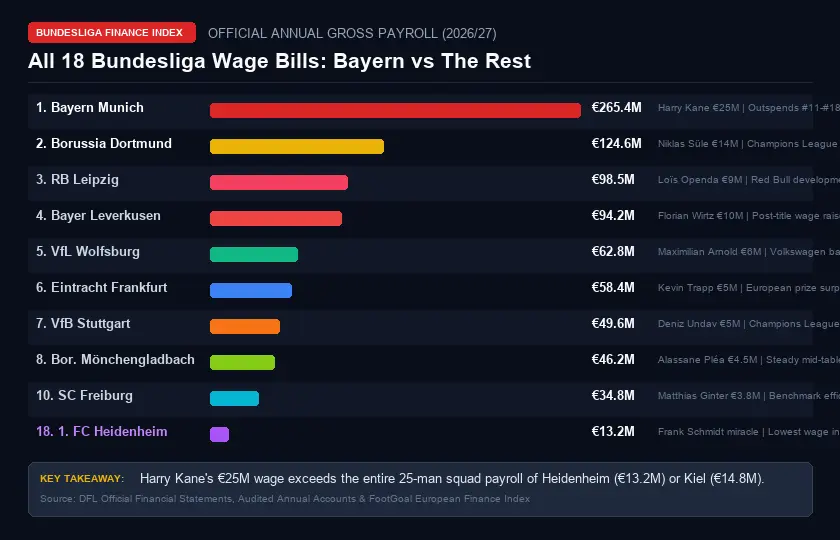
Figure 1: Bundesliga 2026/27 gross payroll distribution. Bayern Munich (€265.4M) commands over 31% of the entire league’s total wage commitments.
Bayern Munich vs. The Rest: The €265M Economic Moat
To understand why Bayern Munich has won 11 of the last 12 Bundesliga titles, you don’t need a tactical whiteboard—you just need a calculator.
Bayern Munich’s gross wage bill of €265.4 million is more than double second-placed Borussia Dortmund (€124.6M) and nearly triple Bayer Leverkusen (€94.2M). In fact, Bayern’s payroll alone accounts for 31.4% of all wages paid across all 18 Bundesliga clubs combined.
Here is why Bayern’s financial lead is virtually unassailable:
- Commercial Supremacy: Bayern generates over €380 million in commercial partnerships alone (Allianz, Adidas, Audi, Telekom). That commercial revenue alone is larger than the total turnover of 15 other Bundesliga clubs.
- Superstar Wage Brackets: Bayern pays Harry Kane (€25M gross), Manuel Neuer (€21M), Jamal Musiala (€20M+ post-extension), and Leroy Sané (€18M). No other German club has a single player earning above €14 million.
- Cash Reserves: Bayern holds over €250 million in equity reserves and owns 100% of the Allianz Arena debt-free, meaning zero interest repayments bleed into their operating budget.
How the 50+1 Rule Shapes German Football Finance
Why doesn’t a tech billionaire buy Hamburger SV or Schalke 04 and spend €200 million on players? The answer is the 50+1 Rule (50+1-Regel).
Under DFL regulations, a commercial investor cannot own more than 49% of the voting shares in a German football club. The club’s registered members (the fans) must always retain at least 50% plus one additional vote. This creates two distinct realities:
- The Blessing: German clubs do not go bankrupt from reckless leverage. Ticket prices stay dirt-cheap, clubs are profitable, and fans have a direct democratic voice in boardroom decisions.
- The Curse: Clubs cannot inject hundreds of millions in external equity to compete with Bayern Munich or Premier League giants. A club’s wage bill is strictly limited by how much organic commercial and matchday revenue it can generate.
The Efficiency Miracles: Heidenheim and SC Freiburg
If Bayern Munich represents corporate football royalty, 1. FC Heidenheim and SC Freiburg represent the beating heart of German football romance.
1. FC Heidenheim, managed by Frank Schmidt for over 17 unbroken years, operates with a total squad wage bill of €13.2 million—less than Niklas Süle earns alone at Borussia Dortmund. Yet Heidenheim qualified for European competition and systematically humbled clubs with four times their budget.
Similarly, SC Freiburg (€34.8M wage bill) has finished in European spots repeatedly under disciplined wage ceilings. Freiburg never pays a player more than €3.8 million per year, relying on an elite Schwarzwald academy, long-term managerial stability, and zero external debt.
Frequently Asked Questions (FAQ)
Which Bundesliga club has the highest wage bill?
FC Bayern Munich has the highest wage bill in the Bundesliga by a wide margin, spending an estimated €265.4 million gross annually on first-team salaries in 2026/27. This is more than double the payroll of second-placed Borussia Dortmund (€124.6M).
Who is the highest-paid player in the Bundesliga?
Harry Kane is the highest-paid player in the Bundesliga, earning a gross annual base salary of €25.0 million (approximately €480,000 per week) at FC Bayern Munich.
What is the 50+1 rule in the Bundesliga?
The 50+1 rule is a regulation by the Deutsche Fußball Liga (DFL) stipulating that club members (the fans) must retain a majority of the voting rights (50% plus one vote) in the commercial entity that runs the football team. It prevents external commercial investors from taking complete control of German clubs.
Which club has the lowest wage bill in the Bundesliga?
1. FC Heidenheim operates with the lowest wage bill in the Bundesliga at €13.2 million gross per year, followed closely by Holstein Kiel (€14.8M) and FC St. Pauli (€16.5M).
How do Bundesliga clubs afford lower wage bills than the Premier League?
The DFL enforces strict annual licensing procedures requiring clubs to show full liquidity, low debt service, and sustainable wage-to-revenue ratios (usually under 60%). Because of the 50+1 rule, German clubs cannot rely on external billionaire debt financing and must live strictly within their earned revenue.
Official Financial Data & Regulatory Sources
The wage bill benchmarks, 50+1 compliance statistics, and personnel cost metrics in this article were verified through official German football authorities:
- DFL (Deutsche Fußball Liga) Official Economic & Licensing Reports — Annual financial benchmarks of professional German football, liquidity ratio compliance, and Personalkosten disclosures.
- FC Bayern München AG Audited Annual Financial Disclosures — Official Jahreshauptversammlung financial statements, commercial revenue breakdowns, and club equity records.