

FootGoal Transfer Deficit Audit™: Key Takeaways
- Chelsea’s €855M Chasm: Chelsea FC lead world football by a colossal margin, racking up an audited five-season net spend deficit of -€855.0 million following Todd Boehly and Clearlake Capital’s unprecedented squad overhaul.
- Manchester United’s Resale Struggle: Manchester United (-€650.0M) sit second globally, having spent nearly €1 billion on new acquisitions while recovering just €270 million in player departures.
- The Saudi Pro League Incursion: State-backed Riyadh giant Al-Hilal (-€425.0M) ranks fourth worldwide, out-spending traditional European powerhouses like Barcelona, Bayern Munich, and Liverpool combined.
- Premier League Dominance: Seven of the world’s ten highest net spenders compete in the English Premier League, demonstrating the unmatched financial gulf created by English domestic and global broadcast revenues.
When football supporters evaluate transfer windows, total gross spend often grabs the headlines. We see eye-watering £100M figures splashed across social media and celebrate marquee unveilings. But within the disciplined world of football corporate finance, gross expenditure tells only half the story. The true test of a club’s transfer sustainability is net spend: total money spent on new signings minus total cash recouped from player sales.
A club that spends €200 million but generates €180 million through player exits operates on a sustainable -€20 million net deficit. Conversely, a club that spends €150 million but fails to offload surplus players faces a punishing -€150 million hole in their balance sheet. Under UEFA Financial Sustainability Regulations (FSR) and the Premier League’s Profitability and Sustainability Rules (PSR), runaway net spend deficits are the fastest route to regulatory fines, squad registration bans, and league point deductions.
As explored in our companion study on the most profitable player transfers in football history, clubs with elite player trading models can balance the books with ease. But what about the football clubs spending vastly more than they recoup? To find out, FootGoal audited five-year transfer market records across FIFA TMS filings, statutory club accounts, and CIES Football Observatory benchmarks. Here is the definitive ranking of the Top 10 Football Clubs with the Highest Net Spend Over the Last 5 Seasons.
Top 10 Football Clubs with the Highest 5-Year Net Spend (Audited Deficits)
The table below ranks the ten clubs with the largest negative transfer balances over the last five completed seasons, detailing total gross transfer expenditure, total sales income, and cumulative net spend deficit.
| Rank | Club | Domestic League | Total Expenditure | Player Sales Income | Cumulative Net Spend Deficit |
|---|---|---|---|---|---|
| 1 | Chelsea FC | Premier League (England) | €1,350,000,000 | €495,000,000 | -€855,000,000 |
| 2 | Manchester United | Premier League (England) | €920,000,000 | €270,000,000 | -€650,000,000 |
| 3 | Arsenal | Premier League (England) | €760,000,000 | €270,000,000 | -€490,000,000 |
| 4 | Al-Hilal | Saudi Pro League (Saudi Arabia) | €440,000,000 | €15,000,000 | -€425,000,000 |
| 5 | Paris Saint-Germain | Ligue 1 (France) | €810,000,000 | €390,000,000 | -€420,000,000 |
| 6 | Tottenham Hotspur | Premier League (England) | €670,000,000 | €290,000,000 | -€380,000,000 |
| 7 | Newcastle United | Premier League (England) | €480,000,000 | €135,000,000 | -€345,000,000 |
| 8 | Aston Villa | Premier League (England) | €540,000,000 | €220,000,000 | -€320,000,000 |
| 9 | Al-Nassr | Saudi Pro League (Saudi Arabia) | €320,000,000 | €25,000,000 | -€295,000,000 |
| 10 | Liverpool | Premier League (England) | €490,000,000 | €210,000,000 | -€280,000,000 |
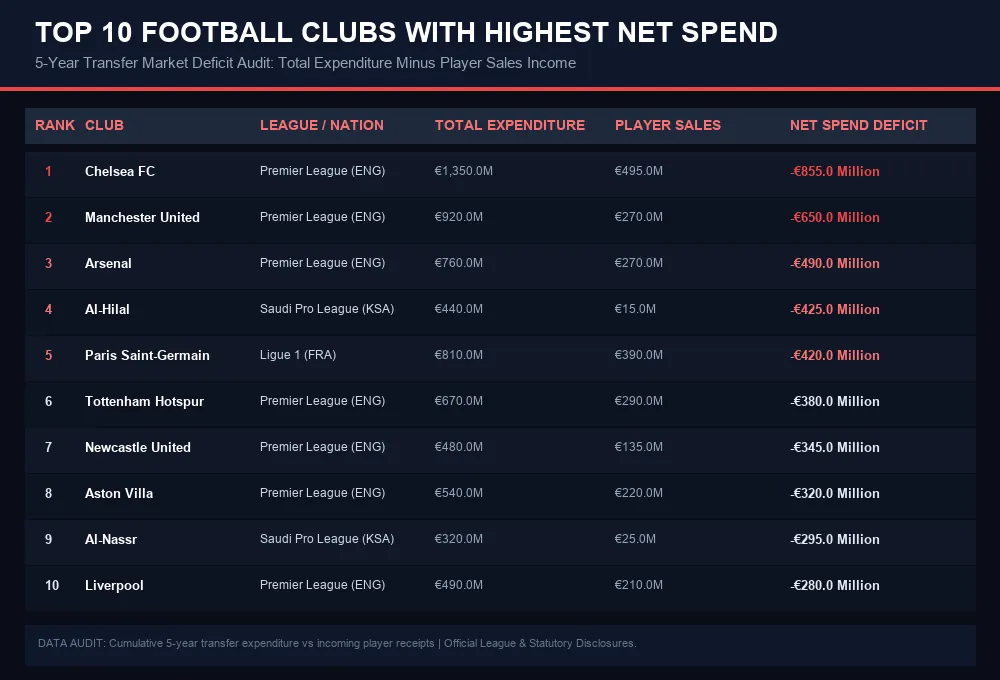
Comparison of cumulative 5-year transfer market deficits across European and global football (FootGoal Transfer Audit).
Deconstructing the Heaviest Transfer Deficits
1. Chelsea FC: The €1.35 Billion Clearlake Experiment (-€855.0M Deficit)
Following the 2022 takeover by Todd Boehly and Clearlake Capital, Chelsea embarked on the most aggressive talent acquisition spree in sporting history. The Blues broke the British transfer record twice in seven months for Enzo Fernández (€121M) and Moisés Caicedo (€133M), committed nine-figure sums to Mykhailo Mudryk and Wesley Fofana, and secured long-term contracts of seven to eight years.
While Chelsea managed to recover nearly €500 million through high-profile sales (Mason Mount, Kai Havertz, Mateo Kovačić, and Conor Gallagher), their colossal €1.35 billion gross spend leaves them with a world-record -€855.0 million cumulative net spend deficit. To balance these figures under PSR, Chelsea have relied heavily on selling off-pitch club assets (such as club hotels and real estate) to sister companies.
2. Manchester United: The Cost of Poor Resale Recovery (-€650.0M Deficit)
Manchester United’s net spend dilemma is defined not by reckless over-spending, but by an inability to extract resale value from departing assets. Across five seasons, United spent €920 million on high-profile recruits including Antony (€95M), Casemiro (€70M), Rasmus Højlund (€75M), and Mason Mount (€64M).
However, because United routinely hand players top-of-market weekly wages, offloading surplus talent becomes nearly impossible without subsidizing severance fees or accepting token sums. Recouping just €270 million across five years creates a staggering -€650.0 million deficit, forcing new minority owners Ineos to initiate severe corporate restructuring.
3. The Saudi Pro League: Al-Hilal’s Disruption (-€425.0M Deficit)
Perhaps the most seismic structural shift in the global transfer market is the entry of Saudi Arabia’s Public Investment Fund (PIF). Backed by an $925 billion sovereign balance sheet, as detailed in our audit of the wealthiest football club owners, Al-Hilal spent €440 million to secure world-class talent including Neymar, Malcom, Rúben Neves, and Aleksandar Mitrović.
Because the Saudi Pro League is in its initial global expansion phase, outbound player sales are virtually non-existent (€15M over 5 years). This yields a -€425.0 million net deficit, demonstrating that state-backed projects prioritize rapid league elevation over traditional transfer trading margins.
Why Manchester City & Real Madrid Avoided the Top 5
Supporters often assume that European powerhouses Manchester City and Real Madrid must top every spending leaderboard. In reality, both clubs operate vastly superior trading models:
- Manchester City’s Academy Goldmine: While City invested heavily in Erling Haaland, Jack Grealish, and Joško Gvardiol, they offset those fees by selling academy graduates and squad players (Cole Palmer, Raheem Sterling, Gabriel Jesus, Oleksandr Zinchenko, and Julián Álvarez) for over £400 million in combined receipts.
- Real Madrid’s Bosman Strategy: Real Madrid secured superstar talents like Kylian Mbappé, Antonio Rüdiger, and David Alaba on free transfers without paying a penny in transfer fees, preserving capital for targeted blockbuster moves like Jude Bellingham while maintaining a modest 5-year net spend of approximately -€180 million.
Frequently Asked Questions (FAQ)
Which football club has the highest net spend in the world over the last 5 seasons?
Chelsea FC have the highest net spend in world football over the last five seasons, accumulating an audited net transfer deficit of -€855.0 million after spending €1.35 billion on new signings against €495 million in player sales.
What is the difference between gross spend and net spend?
Gross spend is the total monetary expenditure on buying new players. Net spend is total expenditure minus all income received from selling players, providing a true reflection of a club’s transfer cash deficit.
Why is Manchester United’s net spend so high compared to Manchester City?
While both clubs spend heavily on new talent, Manchester City recoup massive sums by selling academy graduates and rotating squad stars (over €450M in sales). Manchester United have struggled to generate resale profit, recouping only €270 million across five seasons.
How does high net spend affect Financial Fair Play (FFP)?
High net spend directly inflates annual squad amortisation and operational losses. Under UEFA’s Squad Cost Rule and the Premier League’s PSR, excessive deficits without matching commercial revenue trigger point deductions and European squad limitations.
Which non-European club has the highest net spend?
Al-Hilal of the Saudi Pro League has the highest net spend outside Europe, recording a five-year deficit of -€425.0 million following major acquisitions backed by the Public Investment Fund (PIF).
Official Financial Data & Regulatory Sources
The transfer expenditure records, player sales metrics, and net deficit calculations in this study were verified through official governing body reports and sports observatory databases:
- CIES Football Observatory Financial & Transfer Analysis Reports — Audited five-year global net spend benchmarks, club balance sheet calculations, and transfer volume registries.
- UEFA Club Licensing and Financial Sustainability Regulations (FSR) — Statutory club filings on squad cost limits, amortised transfer balances, and compliance auditing frameworks.